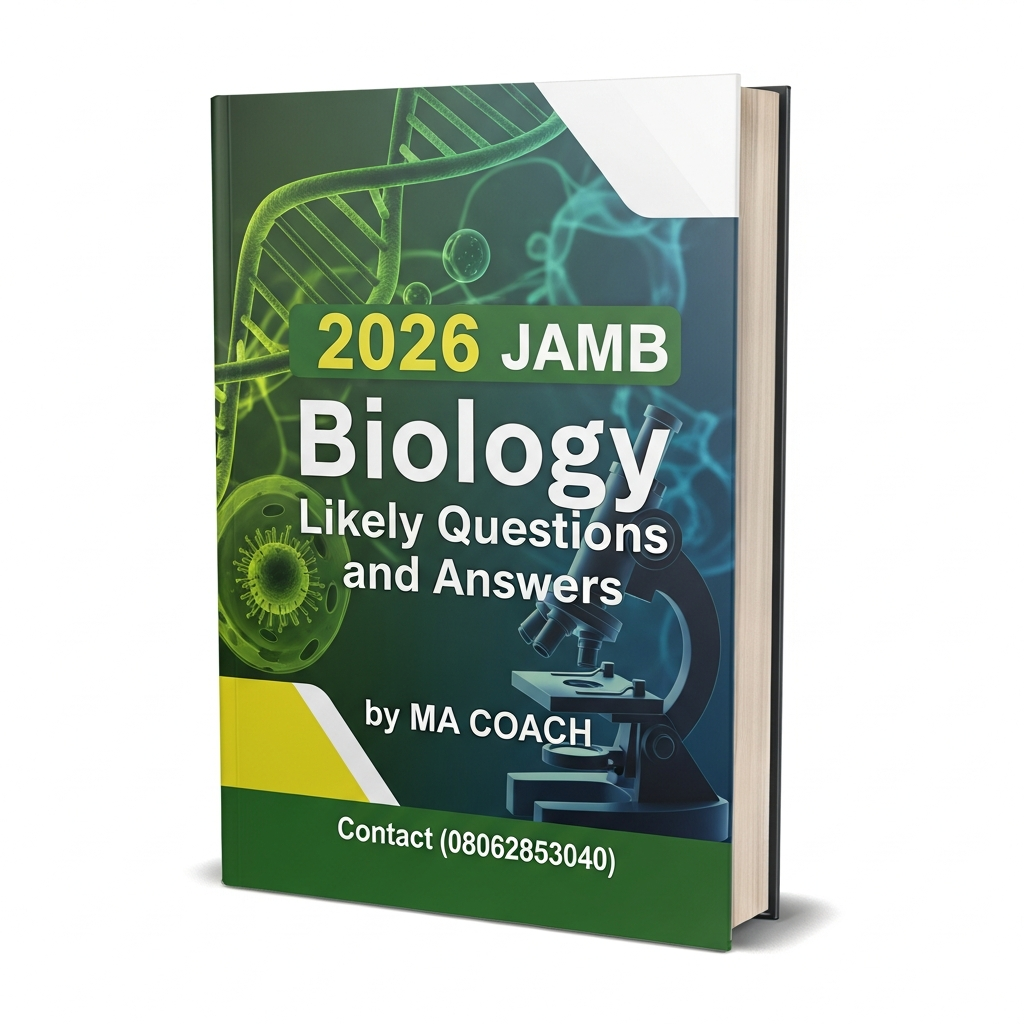
2026 JAMB Biology Likely Questions and Answers to Score 90+

with details explanations

2026 JAMB Biology Likely Questions and Answers to Score 90+

2026 JAMB Biology Likely Questions and Answers to Score 90+ by macoach.com.ng

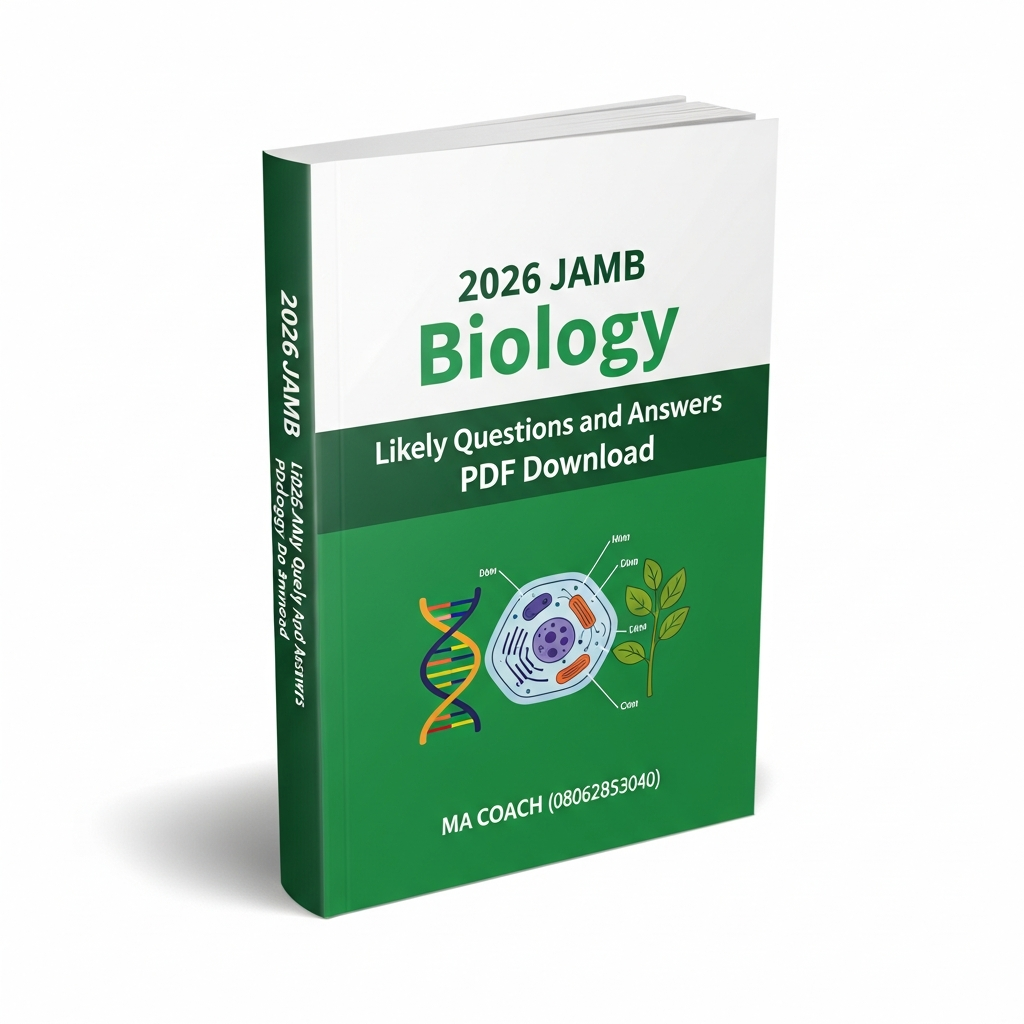
If you are preparing seriously for the UTME, then 2026 JAMB Biology likely questions and answers should be part of your daily study plan. Biology is one of the most scoring subjects in JAMB when properly prepared. Many high-scoring candidates rely on 2026 JAMB Biology likely questions and answers to understand repeated topics, exam patterns, and commonly tested concepts.


This guide provides carefully selected 2026 JAMB Biology likely questions and answers based on past trends, syllabus analysis, and examiner focus areas. Studying these questions increases your chances of scoring 90+ in JAMB Biology.

Instructor

MA COACH

Last updated

today

Total Viewers

1k+

Exams

JAMB

2026 JAMB Biology Likely Questions and Answers to Score 90+

Join Our Social media for latest updates and reading classes

Question 1

Question: The cilia in paramecium function for
(A) locomotion
(B) respiration
(C) excretion
(D) defence

  • Topic: Cell Biology / Protozoa

  • Correct Option: (A)

  • Explanation: In Paramecium, cilia are tiny, hair-like projections that cover the outside of the cell. They beat rhythmically to propel the organism through water (locomotion) and to sweep food particles into the gullet.

Question 2

Question: The Euglena may be classified as a plant due to its possession of
(A) gullet
(B) flagellum
(C) chloroplast
(D) pellicle

  • Topic: Classification of Living Things

  • Correct Option: (C)

  • Explanation: Euglena is a unique organism that shares characteristics of both plants and animals. The presence of chloroplasts allows it to perform photosynthesis, a distinct plant characteristic. Features like the gullet, flagellum, and pellicle are animal-like structural features.

Question 3

Question: Which of the following is the terminal portion of the alimentary canal of a mammal?
(A) oesophagus
(B) stomach
(C) Rectum
(D) colon

  • Topic: Digestive System

  • Correct Option: (C)

  • Explanation: The alimentary canal ends at the anus. However, among the options provided, the rectum is the final section of the large intestine where faeces are stored before egestion through the anus. The colon precedes the rectum.

Question 4

Question: An organism that dwells on the remains of a dead plant is a/an
(A) parasite
(B) saprophyte
(C) enigma
(D) commensal

  • Topic: Ecology / Nutrition

  • Correct Option: (B)

  • Explanation: Saprophytes (or saprotrophs) are organisms like fungi and bacteria that feed on dead and decaying organic matter. Parasites feed on living hosts.

Question 5

Question: A Secchi disc is used in the determination of
(A) rainfall
(B) tides
(C) waves
(D) turbidity

  • Topic: Ecological Instruments

  • Correct Option: (D)

  • Explanation: A Secchi disc is a black and white circular disc lowered into water to measure transparency. It is used to determine turbidity (cloudiness) and light penetration in aquatic habitats.

Question 6

Question: The blood vessel which carries digested food from the small intestine to the liver is the
(A) renal artery
(B) hepatic portal vein
(C) hepatic artery
(D) renal vein

  • Topic: Circulatory System

  • Correct Option: (B)

  • Explanation: The hepatic portal vein is unique because it begins and ends in capillaries. It transports nutrient-rich blood (containing digested food like glucose and amino acids) directly from the gut (intestine) to the liver for processing.

Question 7

Question: Nitrogen is utilized in
(A) formation of ATP
(B) formation of glucose
(C) photosynthesis
(D) formation of amino acids

  • Topic: Biological Molecules

  • Correct Option: (D)

  • Explanation: Nitrogen is a key component of the amino group (

    −NH2-NH_2
    ) found in all amino acids, which are the building blocks of proteins. Glucose is composed only of Carbon, Hydrogen, and Oxygen.


Question 8

Question: Which of the following organs produces bile?
(A) Gall bladder
(B) pancreas
(C) spleen
(D) liver

  • Topic: Digestive System

  • Correct Option: (D)

  • Explanation: The liver produces bile, which emulsifies fats. The gall bladder only stores and concentrates the bile produced by the liver.

Question 9

Question: Which part of the brain is concerned with reflexes controlling the rate of heartbeat and breathing?
(A) medulla
(B) cerebrum
(C) cerebellum
(D) pineal body

  • Topic: Nervous System

  • Correct Option: (A)

  • Explanation: The medulla oblongata (part of the brainstem) controls involuntary life-sustaining functions, including heart rate, breathing rate, and blood pressure.

Question 10

Question: Which of the following is cold-blooded?
(A) cat
(B) lizard
(C) whale
(D) bird

  • Topic: Vertebrate Zoology

  • Correct Option: (B)

  • Explanation: Lizards are reptiles, which are poikilothermic (cold-blooded), meaning their body temperature changes with the environment. Cats, whales (mammals), and birds are homoiothermic (warm-blooded).

Question 11

Question: A character shown by an organism is due to the effects of
(A) hormones only
(B) genes only
(C) genes and environment
(D) environment only

  • Topic: Genetics

  • Correct Option: (C)

  • Explanation: An organism’s phenotype (physical appearance/character) is the result of the interaction between its genotype (genes) and the environment in which it lives.

Question 12

Question: A tapeworm has no alimentary canal because
(A) it is autotrophic
(B) it does not feed
(C) it absorbs digested food
(D) it has no enzymes

  • Topic: Parasitic Adaptations

  • Correct Option: (C)

  • Explanation: Tapeworms are endoparasites living in the host’s intestine. They lack a digestive system because they live surrounded by pre-digested food, which they absorb directly through their body surface (tegument).

Question 13

Question: External ears of mammals consist of
(A) pinna and tympanum
(B) pinna only
(C) pinna and auditory meatus
(D) meatus only

  • Topic: Sense Organs

  • Correct Option: (C)

  • Explanation: The external ear comprises the pinna (the visible ear flap) and the external auditory meatus (ear canal). The tympanum (eardrum) is the separation between the external and middle ear.

Question 14

Question: Jointed skeleton is absent in
(A) spider
(B) snail
(C) spider
(D) millipede

  • Topic: Classification / Invertebrates

  • Correct Option: (B)

  • Explanation: Spiders and millipedes are Arthropods, characterized by jointed appendages and exoskeletons. Snails are Molluscs; they have a soft body (often with a shell) but lack a jointed skeleton.

Question 15

Question: What is the genotype of a child from a man with normal haemoglobin (AA) and a woman who has sickle-cell haemoglobin (SS)?
(A) AA
(B) SS
(C) AS
(D) O

  • Topic: Genetics

  • Correct Option: (C)

  • Explanation: The father donates the ‘A’ gene, and the mother donates the ‘S’ gene.

    • Cross: AA

      ×\times
      SS


    • Offspring: All children will be AS (Carriers/Sickle Cell Trait).

Question 16

Question: Fehling’s solution will readily change colour from blue to a reddish colour when it is
(A) mixed with sugar solution in the cold
(B) warmed by itself
(C) mixed with a reducing sugar in the cold
(D) warmed with a solution of reducing sugar

  • Topic: Food Tests

  • Correct Option: (D)

  • Explanation: Fehling’s solution tests for reducing sugars (like glucose). The reaction requires heat to reduce the copper(II) ions (blue) to copper(I) oxide (reddish precipitate).

Question 17

Question: The axial skeleton of a mammal does not include the bones of the
(A) skull
(B) tail
(C) limbs
(D) back

  • Topic: Skeletal System

  • Correct Option: (C)

  • Explanation: The skeletal system is divided into Axial and Appendicular.

    • Axial: Skull, Vertebral column (back/tail), Ribs, Sternum.

    • Appendicular: Limbs (arms/legs) and Girdles.

Question 18

Question: Which of the following elements is essential for the formation of haemoglobin?
(A) sodium
(B) Iron
(C) calcium
(D) potassium

  • Topic: Nutrition / Transport

  • Correct Option: (B)

  • Explanation: Iron is the central metallic element in the haem group of the haemoglobin molecule, allowing it to bind to oxygen.

Question 19

Question: Which of the following is an example of discontinuous variation?
(A) skin
(B) colouration
(C) left-handedness
(D) height

  • Topic: Variation

  • Correct Option: (C)

  • Explanation:

    • Continuous variation: Shows a range of values (e.g., height, weight, skin shade).

    • Discontinuous variation: Shows distinct groups with no intermediates. You are either left-handed or right-handed (or ambidextrous, but it’s categorical).

Question 20

Question: Most cells in higher animals retain their power of division except
(A) germ cells
(B) nerve cells
(C) erythrocytes
(D) leucocytes

  • Topic: Cell Biology

  • Correct Option: (B)

  • Explanation: Highly specialized cells often lose the ability to divide. Nerve cells (neurons) are the classic biological example of cells that enter the G0 phase and do not divide once differentiated. (Note: Erythrocytes also cannot divide as they lack a nucleus, but Neurons are the intended answer regarding tissue permanence).

Question 21

Question: A severe deficiency of thyroxine results in
(A) diabetes mellitus
(B) sexual underdevelopment
(C) cretinism
(D) gigantism

  • Topic: Hormones

  • Correct Option: (C)

  • Explanation: Thyroxine controls metabolism. Severe deficiency in infancy leads to cretinism (stunted physical and mental growth).

    • Diabetes = Insulin deficiency.

    • Gigantism = Excess Growth Hormone.

Question 22

Question: The division thallophyta comprises
(A) ferns and mosses
(B) algae and fungi
(C) mosses and liverworts
(D) fungi and ferns

  • Topic: Plant Classification

  • Correct Option: (B)

  • Explanation: Thallophyta refers to plants (or plant-like organisms) with a simple body called a thallus (no true roots, stems, or leaves). This group traditionally includes Algae and Fungi.

Question 23

Question: For an animal to have diastema, it must lack
(A) incisors
(B) molars
(C) canines
(D) premolars

  • Topic: Dentition

  • Correct Option: (C)

  • Explanation: A diastema is a natural gap between teeth, commonly found in herbivores (like sheep or rabbits) between the incisors and premolars. This gap exists because the canines are absent.

Question 24

Question: Parenchyma cells serve as supporting tissue when they
(A) contain crystals
(B) become turgid
(C) become flaccid
(D) lose chloroplasts

  • Topic: Plant Tissues

  • Correct Option: (B)

  • Explanation: In herbaceous plants, support is largely provided by turgor pressure. When parenchyma cells absorb water and become turgid, they press against each other, making the plant stem firm.

Question 25

Question: The mineral nutrient that easily gets leached out of the soil is
(A) phosphorus
(B) nitrate
(C) calcium
(D) magnesium

  • Topic: Soil Science

  • Correct Option: (B)

  • Explanation: Nitrates are highly soluble in water and are not held tightly by soil particles (which are negatively charged, just like nitrate ions). Therefore, they wash away (leach) easily with rain or irrigation.

Question 26

Question: Hydra removes undigested food by
(A) passing it through the mouth
(B) passing it through the anus
(C) passing it through the body surface
(D) passing it through its contractile vacuole

  • Topic: Invertebrate Physiology

  • Correct Option: (A)

  • Explanation: Hydra has a simple body plan with a gastrovascular cavity that has only one opening. This single opening serves as both the mouth (for ingestion) and the exit for undigested waste (egestion). It does not have an anus.

Question 27

Question: A feature which adapts birds to flight is the possession of
(A) scales
(B) legs
(C) light bones
(D) pointed beaks

  • Topic: Adaptation

  • Correct Option: (C)

  • Explanation: To fly efficiently, an organism needs to minimize weight. Birds have pneumatic (hollow and light) bones to reduce body mass while maintaining strength.

Question 28

Question: The gill rakers of fishes take part in
(A) feeding
(B) cellular respiration
(C) swimming
(D) diffusion

  • Topic: Fish Biology

  • Correct Option: (A)

  • Explanation: Gill rakers are bony projections on the gill arches. They filter the water before it passes over the delicate gill filaments, preventing debris from damaging the gills and trapping food particles (especially in filter feeders).

Question 29

Question: Epigeal germination can be found in
(A) sorghum
(B) maize
(C) millet
(D) groundnut

  • Topic: Plant Growth

  • Correct Option: (D)

  • Explanation:

    • Epigeal germination: Cotyledons are pushed above the soil (e.g., Groundnut, Bean).

    • Hypogeal germination: Cotyledons remain below the soil (e.g., Maize, Sorghum, Millet – mostly monocots).

Question 30

Question: The greatest contribution to genetic studies was made by
(A) Robert Hooke
(B) Gregor Mendel
(C) Charles Darwin
(D) Thomas Morgan

  • Topic: History of Biology

  • Correct Option: (B)

  • Explanation: Gregor Mendel is known as the “Father of Genetics” for his work with pea plants, where he discovered the fundamental laws of inheritance.

Question 31

Question: Neurons that receive stimuli from the body or internal organs are called
(A) motor neurons
(B) sensory neurons
(C) efferent neurons
(D) relay neurons

  • Topic: Nervous System

  • Correct Option: (B)

  • Explanation: Sensory (afferent) neurons transmit impulses from receptors (sense organs) towards the Central Nervous System (CNS). Motor neurons carry instructions away from the CNS.

Question 32

Question: Which of the following stores carbohydrate as glycogen?
(A) spirogyra
(B) Mangifera
(C) Rattus
(D) Chlamydomonas

  • Topic: Metabolism / Classification

  • Correct Option: (C)

  • Explanation:

    • Plants and Algae (Spirogyra, Mangifera/Mango, Chlamydomonas) store carbohydrates as starch.

    • Animals (Rattus is the genus for Rats) store carbohydrates as glycogen.

Question 33

Question: The sex-linked defect in which very slight cut produces severe bleeding is known as
(A) anaemia
(B) anorexia
(C) haemophilia
(D) haemolysis

  • Topic: Genetics / Diseases

  • Correct Option: (C)

  • Explanation: Haemophilia is a hereditary, sex-linked disorder where the blood fails to clot properly, leading to excessive bleeding from minor injuries.

Question 34

Question: A band of connective tissue linking two bones in a joint is known as
(A) tendon
(B) cartilage
(C) synovial membrane
(D) ligament

  • Topic: Musculoskeletal System

  • Correct Option: (D)

  • Explanation:

    • Ligament: Connects Bone to Bone.

    • Tendon: Connects Muscle to Bone.

Question 35

Question: The speed of the wind can be measured with an instrument called
(A) anemometer
(B) hydrometer
(C) wind vane
(D) barometer

  • Topic: Ecology

  • Correct Option: (A)

  • Explanation:

    • Anemometer: Measures wind speed.

    • Wind vane: Measures wind direction.

    • Barometer: Measures pressure.

Question 36

Question: The organism that has a hydrostatic skeleton is
(A) tilapia
(B) Hydra
(C) earthworm
(D) Lizard

  • Topic: Support Systems

  • Correct Option: (C)

  • Explanation: A hydrostatic skeleton uses fluid pressure to provide support and facilitate movement. While Hydra also uses fluid pressure, the earthworm is the most complex and standard example of an organism utilizing a coelomic hydrostatic skeleton for locomotion (peristalsis). Tilapia and Lizards have endoskeletons (bones).

Question 37

Question: Fertilization in humans usually takes place in the
(A) lower part of the uterus
(B) upper part of the uterus
(C) lower part of the oviduct
(D) upper part of the oviduct

  • Topic: Human Reproduction

  • Correct Option: (D)

  • Explanation: Fertilization (the fusion of sperm and egg) occurs in the oviduct (Fallopian tube), specifically in the upper portion known as the ampulla.

Question 38

Question: In mammalian males, the excretory and reproductive systems share the
(A) ureter
(B) testes
(C) vas deferens
(D) urethra

  • Topic: Urogenital System

  • Correct Option: (D)

  • Explanation: In males, the urethra serves a dual purpose: it transports urine from the bladder (excretory) and semen from the vas deferens (reproductive) to the outside of the body.

Question 39

Question: The dominant phase in the life cycle of a bryophyte is the
(A) gametangium
(B) sporophyte
(C) gametophyte
(D) prothallus

  • Topic: Plant Life Cycles

  • Correct Option: (C)

  • Explanation: In Bryophytes (mosses and liverworts), the conspicuous green plant that performs photosynthesis is the gametophyte generation. The sporophyte is dependent on the gametophyte. In higher plants, the sporophyte is dominant.

Question 40

Question: In the mammalian kidney, the Bowman’s capsule is located in the
(A) ureter
(B) pelvis
(C) cortex
(D) medulla

  • Topic: Excretory System

  • Correct Option: (C)

  • Explanation: The nephron is the functional unit of the kidney. The Malpighian corpuscle (which includes the Glomerulus and Bowman’s capsule) is located in the outer layer of the kidney, known as the cortex. The Loop of Henle extends into the medulla.

2026 JAMB Biology likely questions, JAMB Biology questions and answers, JAMB Biology PDF download, JAMB UTME Biology 2026, Biology JAMB CBT practice, JAMB Biology study guide, JAMB Biology exam prep, JAMB past questions Biology

Phone / WhatsApp Number

+2349061221656, +2348062853040

Email

admin@macoach.com.ng

Share to:

Trending Updates

  • Latest post
  • Hidden Facts
  • JAMB Questions and Answers
  • JAMB Updates
  • Job Exam Past Questions & Answers
  • Lesson Note
  • NECO GCE
  • WAEC GCE
  • WAEC GCE Questions and Answers
  • WAEC Questions and Answers
    •   Back
    • JAMB Past Questions and Answers
    • 2026 JAMB English Language Questions and Answers
    • 2026 JAMB Question and Answers
    •   Back
    • Download Nursery 1 Lesson Note For All Subjects
    • Download Nursery 2 Lesson Note for All Subjects
    •   Back
    • JAMB Syllabus PDF
    •   Back
    • Nigerian Customs Service Exams
    • Nigeria Navy
    • Nigeria Air Force NAF
    • Nigerian Security and Civil Defence Corps
    • Nigerian Custom Services Past Questions and Answers PDF
    • Nigeria Navy Past Questions and Answers PDF
    • Nigeria Air Force past questions and answers PDF
    •   Back
    • Nigeria Air Force past questions and answers PDF
    •   Back
    • Nigeria Navy Past Questions and Answers PDF
    •   Back
    • Nigerian Custom Services Past Questions and Answers PDF
    •   Back
    • Nursery School Lesson Note
    • Download Nursery 1 Lesson Note For All Subjects
    • Download Nursery 2 Lesson Note for All Subjects
    •   Back
    • WAEC Past Questions and Answers
    • WAEC Biology Questions and Answers
    •   Back
    • WAEC GCE Mathematics Questions and Answers
Load More

End of Content.

OUR PAGES

  • All Pages
  • Hidden Facts
  • JAMB Questions and Answers
  • JAMB Updates
  • Job Exam Past Questions & Answers
  • Lesson Note
  • NECO GCE
  • WAEC GCE
  • WAEC GCE Questions and Answers
  • WAEC Questions and Answers
    •   Back
    • JAMB Past Questions and Answers
    • 2026 JAMB English Language Questions and Answers
    • 2026 JAMB Question and Answers
    •   Back
    • Download Nursery 1 Lesson Note For All Subjects
    • Download Nursery 2 Lesson Note for All Subjects
    •   Back
    • JAMB Syllabus PDF
    •   Back
    • Nigerian Customs Service Exams
    • Nigeria Navy
    • Nigeria Air Force NAF
    • Nigerian Security and Civil Defence Corps
    • Nigerian Custom Services Past Questions and Answers PDF
    • Nigeria Navy Past Questions and Answers PDF
    • Nigeria Air Force past questions and answers PDF
    •   Back
    • Nigeria Air Force past questions and answers PDF
    •   Back
    • Nigeria Navy Past Questions and Answers PDF
    •   Back
    • Nigerian Custom Services Past Questions and Answers PDF
    •   Back
    • Nursery School Lesson Note
    • Download Nursery 1 Lesson Note For All Subjects
    • Download Nursery 2 Lesson Note for All Subjects
    •   Back
    • WAEC Past Questions and Answers
    • WAEC Biology Questions and Answers
    •   Back
    • WAEC GCE Mathematics Questions and Answers
Load More

End of Content.

1 Comment

  • Adamu hassan

    07060708643

Leave a Comment

Your email address will not be published. Required fields are marked *

Popular Posts

  • All Posts
  • Hidden Facts
  • JAMB Questions and Answers
  • JAMB Updates
  • Job Exam Past Questions & Answers
  • Lesson Note
  • NECO GCE
  • WAEC GCE
  • WAEC GCE Questions and Answers
  • WAEC Questions and Answers
    •   Back
    • JAMB Past Questions and Answers
    • 2026 JAMB English Language Questions and Answers
    • 2026 JAMB Question and Answers
    •   Back
    • Download Nursery 1 Lesson Note For All Subjects
    • Download Nursery 2 Lesson Note for All Subjects
    •   Back
    • JAMB Syllabus PDF
    •   Back
    • Nigerian Customs Service Exams
    • Nigeria Navy
    • Nigeria Air Force NAF
    • Nigerian Security and Civil Defence Corps
    • Nigerian Custom Services Past Questions and Answers PDF
    • Nigeria Navy Past Questions and Answers PDF
    • Nigeria Air Force past questions and answers PDF
    •   Back
    • Nigeria Air Force past questions and answers PDF
    •   Back
    • Nigeria Navy Past Questions and Answers PDF
    •   Back
    • Nigerian Custom Services Past Questions and Answers PDF
    •   Back
    • Nursery School Lesson Note
    • Download Nursery 1 Lesson Note For All Subjects
    • Download Nursery 2 Lesson Note for All Subjects
    •   Back
    • WAEC Past Questions and Answers
    • WAEC Biology Questions and Answers
    •   Back
    • WAEC GCE Mathematics Questions and Answers
Load More

End of Content.

Blog Category

Get in Touch

Phone Number

+2349061221656, +2348062853040

Email

admin@macoach.com.ng

Address

2nd Floor former joybell nursery & primary school opposite lotogbe junction ondo city, ondo state

Business Hours

Monday — Friday 8am – 11pm
Saturday — 8am – 10pm
Sunday — Closed

Tags

Newsletter Signup

Name

About Us

MACOACH.com.ng –Your No.1 Online Academy for Daily Mathematics Lessons, Textbook Solutions, and Exam Preparation in Nigeria.

Departments

Mathematics Lesson

Lesson Note

Exam's past Questions

Maths Textbooks Exercises Solution

Learn Skills

Quick Links

About Us

Terms and Conditions

Privacy Policy

Contact Us

Declaimer

Refund Policy

Recent news

  • All Post
  • Hidden Facts
  • JAMB Questions and Answers
  • JAMB Updates
  • Job Exam Past Questions & Answers
  • Lesson Note
  • NECO GCE
  • WAEC GCE
  • WAEC GCE Questions and Answers
  • WAEC Questions and Answers
    •   Back
    • JAMB Past Questions and Answers
    • 2026 JAMB English Language Questions and Answers
    • 2026 JAMB Question and Answers
    •   Back
    • Download Nursery 1 Lesson Note For All Subjects
    • Download Nursery 2 Lesson Note for All Subjects
    •   Back
    • JAMB Syllabus PDF
    •   Back
    • Nigerian Customs Service Exams
    • Nigeria Navy
    • Nigeria Air Force NAF
    • Nigerian Security and Civil Defence Corps
    • Nigerian Custom Services Past Questions and Answers PDF
    • Nigeria Navy Past Questions and Answers PDF
    • Nigeria Air Force past questions and answers PDF
    •   Back
    • Nigeria Air Force past questions and answers PDF
    •   Back
    • Nigeria Navy Past Questions and Answers PDF
    •   Back
    • Nigerian Custom Services Past Questions and Answers PDF
    •   Back
    • Nursery School Lesson Note
    • Download Nursery 1 Lesson Note For All Subjects
    • Download Nursery 2 Lesson Note for All Subjects
    •   Back
    • WAEC Past Questions and Answers
    • WAEC Biology Questions and Answers
    •   Back
    • WAEC GCE Mathematics Questions and Answers

© 2025 Created with MA COACH

error: Content is protected !!