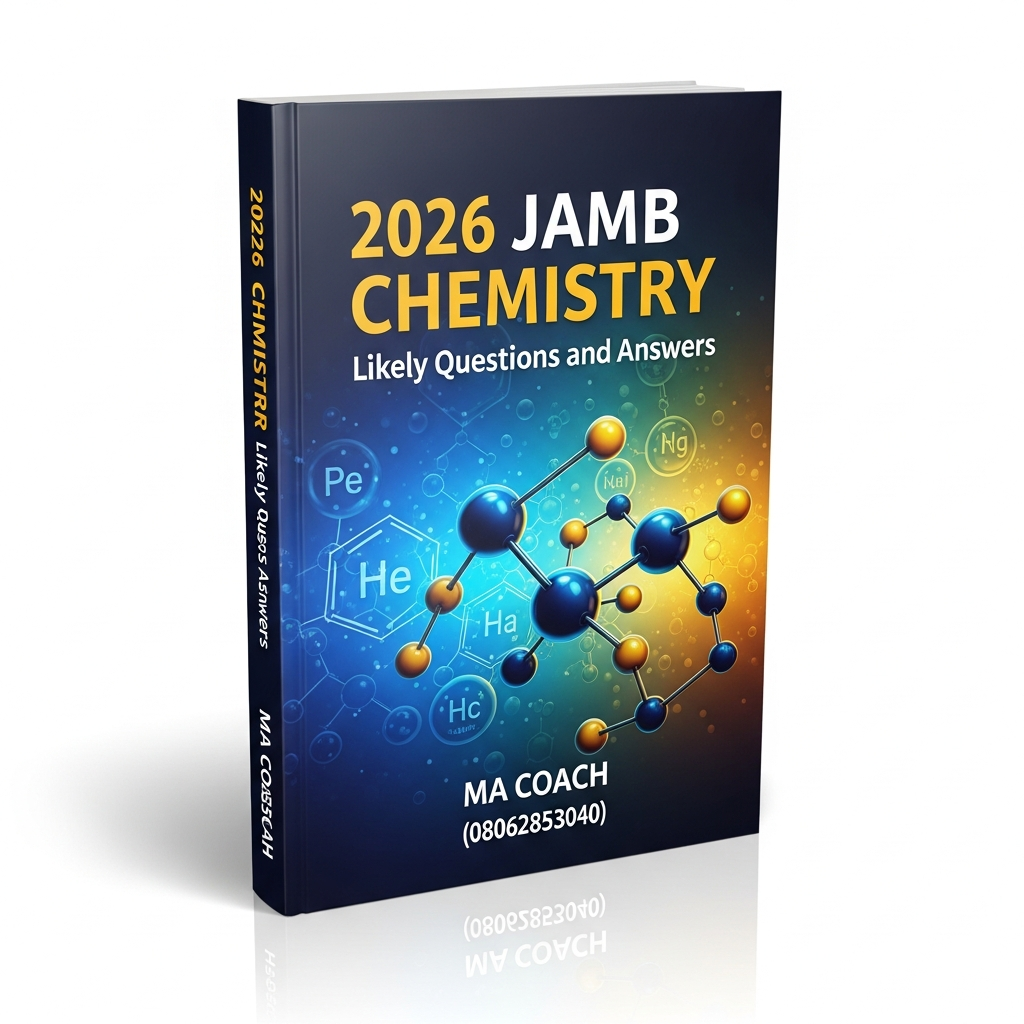
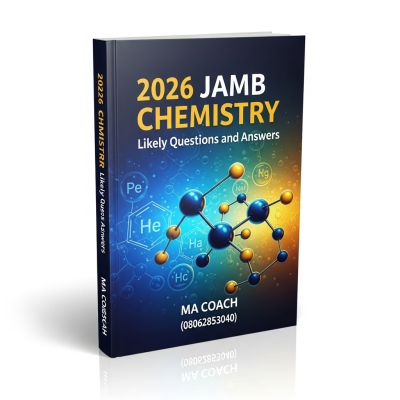
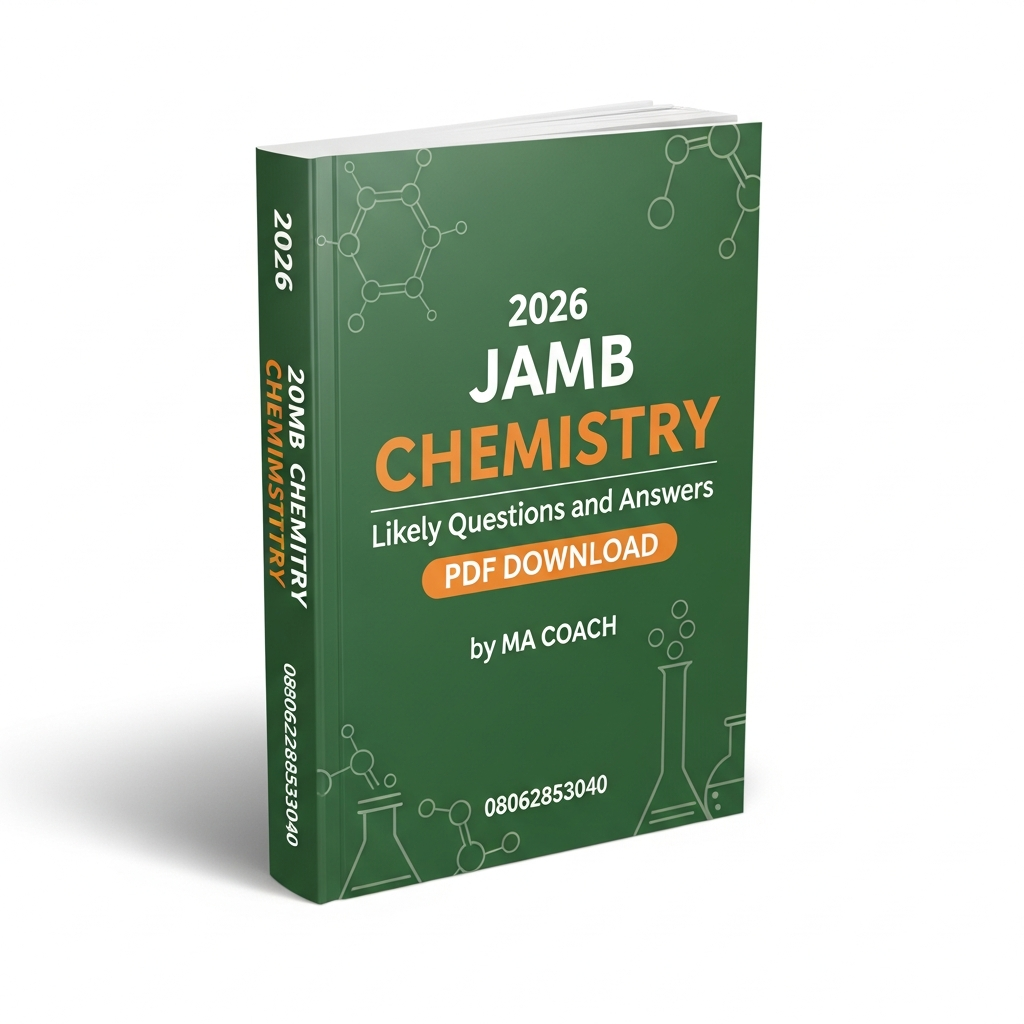
2026 JAMB Chemistry likely Questions and Answers PDF Download

with details explanations

2026 JAMB Chemistry likely Questions and Answers PDF Download

2026 JAMB Chemistry likely questions and answers by macoach.com.ng

Preparing for the 2026 JAMB Chemistry examination requires smart study strategies, and one of the most effective methods is practicing 2026 JAMB Chemistry likely questions and answers. Chemistry is a core science subject in UTME, and many questions are repeated or slightly modified from previous years.


In this post, you will find 2026 JAMB Chemistry likely questions and answers, well-explained solutions, exam tips, and a free downloadable PDF to help you score high in your UTME.

Instructor

MA COACH

Last updated

today

Total Viewers

1k+

Exams

JAMB

2026 JAMB Chemistry likely Questions and Answers

Join Our Social media for latest updates and reading classes


Question 1

Question: Given that the difference in electronegativity of elements X and Y is 2.2, the bond that will be formed between them is
(a) polar covalent
(b) ionic
(c) non-polar covalent
(d) coordinate

  • Topic: Chemical Bonding

  • Correct Option: (b)

  • Detailed Explanation: The type of chemical bond formed is determined by the difference in electronegativity values between the combining atoms.

    • Difference < 0.4: Non-polar covalent.

    • Difference between 0.5 and 1.7: Polar covalent.

    • Difference > 1.7: Ionic (Electrovalent).

    • Since 2.2 is greater than 1.7, the bond is ionic.

Question 2

Question: The radiation used in studying the arrangement of particles in giant organic molecules is
(a)

β\beta

-particles
(b)

γ\gamma

-rays
(c)

α\alpha

-particles
(d) X-rays


  • Topic: Analytical Chemistry / Crystallography

  • Correct Option: (d)

  • Detailed Explanation: X-ray crystallography is the standard technique used to determine the atomic and molecular structure of a crystal. By analyzing the diffraction patterns produced when X-rays pass through the crystal, scientists can deduce the arrangement of particles in giant molecules (like DNA or proteins).

Question 3

Question: i.

CaCO3CaCO_3

ii.

Ca(HCO3)2Ca(HCO_3)_2

iii.

CaSO4CaSO_4

. Which of the above causes temporary water hardness if present in water?
(a) i only
(b) ii only
(c) iii only
(d) i & ii


  • Topic: Water Hardness

  • Correct Option: (b)

  • Detailed Explanation:

    • Temporary Hardness is caused by dissolved bicarbonates (hydrogentrioxocarbonate(IV)) of calcium and magnesium, specifically

              Ca(HCO3)2Ca(HCO_3)_2 
      . It can be removed by boiling.


    • Permanent Hardness is caused by sulfates (

      CaSO4CaSO_4
      ) or chlorides.


    •  

      CaCO3CaCO_3
      is insoluble and forms the “scale” or precipitate, but the dissolved bicarbonate causes the initial hardness.


Question 4

Question: The dispersion of a liquid in a liquid medium will give
(a) an emulsion
(b) a sol
(c) an aerosol
(d) a fog

  • Topic: Colloids

  • Correct Option: (a)

  • Detailed Explanation: A colloid where both the dispersed phase and the dispersion medium are liquids is called an emulsion. Examples include milk and mayonnaise.

Question 5

Question: The respective basicities of

HNO3,HCl,CH3COOHHNO_3, HCl, CH_3COOH

and

H2SO4H_2SO_4

are
(a) 1, 1, 4 & 2
(b) 1, 1, 3 & 2
(c) 1, 1, 1 & 2
(d) 1, 1, 3 & 1


  • Topic: Acids, Bases, and Salts

  • Correct Option: (c)

  • Detailed Explanation: Basicity is the number of replaceable hydrogen ions (

    H+H^+
    ) in one molecule of an acid.


    •  

      HNO3→H++NO3−HNO_3 \rightarrow H^+ + NO_3^-
      (Basicity = 1)


    •  

      HCl→H++Cl−HCl \rightarrow H^+ + Cl^-
      (Basicity = 1)


    •  

      CH3COOH→H++CH3COO−CH_3COOH \rightarrow H^+ + CH_3COO^-
      (Organic acid, only the carboxyl H is replaceable. Basicity = 1)


    •  

      H2SO4→2H++SO42−H_2SO_4 \rightarrow 2H^+ + SO_4^{2-}
      (Basicity = 2)


Question 6

Question:

C(s)+H2O(g)→CO(g)+H2(g)C(s) + H_2O(g) \rightarrow CO(g) + H_2(g)

. The oxidizing agent in the reaction above is
(a)

COCO


(b)

H2H_2


(c)

H2OH_2O


(d)

CC


  • Topic: Redox Reactions

  • Correct Option: (c)

  • Detailed Explanation:

    • Oxidation state of C changes from 0 to +2 (Oxidation).

    • Oxidation state of H in

      H2OH_2O
      changes from +1 to 0 (Reduction).


    • The substance that is reduced serves as the oxidizing agent. Therefore,

              H2OH_2O 
      is the oxidizing agent.


Question 7

Question: How many coulombs of electricity will be needed to deposit 22.22g of silver?
(a) 20212.3C
(b) 14189C
(c) 25719C
(d) 19854C

  • Topic: Electrolysis

  • Correct Option: (d)

  • Detailed Explanation:

    • Reaction:

      Ag++e−→AgAg^+ + e^- \rightarrow Ag


    • 1 Mole of electrons (1 Faraday = 96500 C) deposits 1 Mole of Ag (108g).

    • Formula:

      Q=mass×96500Molar MassQ = \frac{\text{mass} \times 96500}{\text{Molar Mass}}


    •  

      Q=22.22×96500108Q = \frac{22.22 \times 96500}{108}


    •  

      Q≈19853.9CQ \approx 19853.9C
      , which rounds to 19854C.


Question 8

Question: A compound that gives a brick-red colour to a non-luminous flame is likely to contain
(a)

Al3+Al^{3+}


(b)

Na+Na^+


(c)

Ca2+Ca^{2+}


(d)

Cu2+Cu^{2+}


  • Topic: Qualitative Analysis (Flame Test)

  • Correct Option: (c)

  • Detailed Explanation:

    •  

      Na+Na^+
      gives a Golden Yellow flame.


    •  

      Cu2+Cu^{2+}
      gives a Blue-Green flame.


    •  

              Ca2+Ca^{2+} 
      gives a Brick-Red flame.


Question 9

Question: The general formula of haloalkanes where X represents the halide is
(a)

CnH2n−1XC_nH_{2n-1}X


(b)

CnH2n+1XC_nH_{2n+1}X


(c)

CnH2n−2XC_nH_{2n-2}X


(d)

CnH2nXC_nH_{2n}X


  • Topic: Organic Chemistry

  • Correct Option: (b)

  • Detailed Explanation: Alkanes have the general formula

    CnH2n+2C_nH_{2n+2}
    . To form a haloalkane (alkyl halide), one hydrogen atom is replaced by a halogen atom (
    XX
    ).


    •  

      CnH2n+2→C_nH_{2n+2} \rightarrow
      Remove H
      →CnH2n+1→\rightarrow C_nH_{2n+1} \rightarrow
      Add X
      →\rightarrow
      CnH2n+1XC_nH_{2n+1}X
      .


Question 10

Question: Which of the following is generated when ethyne is passed through a hot tube containing organo-nickel catalyst?
(a) Benzene
(b) Polythene
(c) Butyne
(d) Phenol

  • Topic: Organic Chemistry (Polymerization)

  • Correct Option: (a)

  • Detailed Explanation: This is a polymerization reaction (specifically cyclic polymerization). When Ethyne (

    C2H2C_2H_2
    ) is passed through a hot tube with a catalyst, three molecules combine to form Benzene (
    C6H6C_6H_6
    ).


    •  

      3C2H2→C6H63C_2H_2 \rightarrow C_6H_6


Question 11

Question: The petroleum fraction in industries is in heating furnaces in industries is
(a) diesel oil
(b) kerosene
(c) petrol
(d) none

  • Topic: Industrial Chemistry (Petroleum)

  • Correct Option: (a)

  • Detailed Explanation: While heavy fuel oils are often used for large furnaces, in the context of these options and standard WAEC/JAMB curriculum, Diesel oil (or Gas oil) is the fraction heavier than kerosene and petrol used for heating systems and industrial engines/furnaces.

Question 12

Question: What is the molar mass of a gas if 2.0g of the gas occupies a volume of

400cm3400cm^3

at stp?
(a)

28gmol−128gmol^{-1}


(b)

14gmol−114gmol^{-1}


(c)

56gmol−156gmol^{-1}


(d)

112gmol−1112gmol^{-1}


  • Topic: Stoichiometry (Gas Laws)

  • Correct Option: (d)

  • Detailed Explanation:

    • At STP, 1 mole of gas occupies

      22,400cm322,400 cm^3
      .


    • If

      400cm3400 cm^3
      weighs 2.0g, we need to find the weight of
      22,400cm322,400 cm^3
      .


    •  

      Molar Mass=2.0g400cm3×22400cm3\text{Molar Mass} = \frac{2.0g}{400cm^3} \times 22400cm^3


    •  

      Molar Mass=0.005×22400=112gmol−1\text{Molar Mass} = 0.005 \times 22400 = 112 gmol^{-1}
      .


Question 13

Question: The following factors have no effect on the value of the equilibrium constant except
(a) temperature
(b) pressure
(c) concentration
(d) none of the above

  • Topic: Chemical Equilibrium

  • Correct Option: (a)

  • Detailed Explanation: The equilibrium constant (

    KcK_c
    or
    KpK_p
    ) is a constant value for a specific reaction at a specific temperature. Changing concentration or pressure shifts the position of equilibrium to maintain the constant, but does not change the constant itself. Only a change in temperature changes the actual value of the equilibrium constant.


Question 14

Question: What volume of CO produced by reacting excess carbon with

5dm35dm^3

of oxygen?
(a)

5dm35dm^3


(b)

8dm38dm^3


(c)

10dm310dm^3


(d)

2.5dm32.5dm^3


  • Topic: Stoichiometry

  • Correct Option: (c)

  • Detailed Explanation:

    • Reaction:

      2C(s)+O2(g)→2CO(g)2C(s) + O_2(g) \rightarrow 2CO(g)


    • According to Gay-Lussac’s law, the ratio of volumes of gases corresponds to the stoichiometric coefficients.

    • Ratio

      O2:COO_2 : CO
      is
      1:21 : 2
      .


    • Volume

      CO=2×Volume O2=2×5dm3=10dm3CO = 2 \times \text{Volume } O_2 = 2 \times 5dm^3 = 10dm^3
      .


Question 15

Question: The shape of the carbon (iv) oxide molecule is
(a) tetrahedral
(b) angular
(c) linear
(d) pyramidal

  • Topic: Chemical Bonding (VSEPR)

  • Correct Option: (c)

  • Detailed Explanation: Carbon dioxide (

    CO2CO_2
    ) has double bonds between the central Carbon and the Oxygen atoms (
    O=C=OO=C=O
    ). There are no lone pairs on the central carbon atom. According to VSEPR theory, this results in a linear shape with a bond angle of
    180∘180^\circ
    .


Question 16

Question: What type of bond can be formed between two elements with electronic structures

1s22s22p41s^22s^22p^4

and

1s22s22p21s^22s^22p^2

?
(a) ionic
(b) metallic
(c) covalent
(d) dative


  • Topic: Chemical Bonding

  • Correct Option: (c)

  • Detailed Explanation:

    • Element 1 (

      1s22s22p41s^22s^22p^4
      ) has 8 electrons total (Oxygen, Group 6). It is a non-metal.


    • Element 2 (

      1s22s22p21s^22s^22p^2
      ) has 6 electrons total (Carbon, Group 4). It is a non-metal.


    • Bonds formed between two non-metals are covalent (sharing of electrons).

Question 17

Question: When water is added to anhydrous

CoCl2CoCl_2

, the colour changes from
(a) white to blue
(b) blue to white
(c) blue to pink
(d) pink to white


  • Topic: Transition Metals

  • Correct Option: (c)

  • Detailed Explanation: Cobalt(II) chloride serves as a test for water.

    • Anhydrous

      CoCl2CoCl_2
      is Blue.


    • Hydrated

      CoCl2⋅6H2OCoCl_2 \cdot 6H_2O
      is Pink.


    • Therefore, adding water changes it from Blue to Pink.

Question 18

Question: The following are salts except
(a) zinc nitrate
(b) sodium carbonate
(c) calcium oxide
(d) magnesium chloride

  • Topic: Acids, Bases, and Salts

  • Correct Option: (c)

  • Detailed Explanation:

    • Zinc nitrate, Sodium carbonate, and Magnesium chloride are all salts (products of acid-base neutralization).

    • Calcium oxide (

      CaOCaO
      ) is a metal oxide, which acts as a Base (specifically a basic oxide), not a salt.


Question 19

Question: In an electrochemical cell, polarization is caused by
(a) oxygen
(b) hydrogen
(c) chlorine
(d) tetraoxosulphate(vi)acid

  • Topic: Electrochemistry

  • Correct Option: (b)

  • Detailed Explanation: Polarization occurs in simple cells when Hydrogen gas bubbles accumulate around the copper anode (positive electrode). This insulates the electrode and sets up a back electromotive force, stopping the current flow.

Question 20

Question: A metal that forms soluble trioxosulphate(iv) salt is
(a) manganese
(b) aluminum
(c) barium
(d) potassium

  • Topic: Solubility Rules

  • Correct Option: (d)

  • Detailed Explanation: Trioxosulphate(IV) salts are Sulfites (

    SO32−SO_3^{2-}
    ). Most sulfites are insoluble in water, except for those of Alkali metals (Group 1) and Ammonium.


    • Potassium is a Group 1 alkali metal, so

      K2SO3K_2SO_3
      is soluble.


Question 21

Question: 2-methylpropan-2-ol is a/an _______ alkanol
(a) primary
(b) secondary
(c) tertiary
(d) incombustible

  • Topic: Organic Chemistry (Alcohols)

  • Correct Option: (c)

  • Detailed Explanation:

    • Structure: The Carbon holding the OH group is bonded to three other methyl groups (

      CH3CH_3
      ).


    •  

      CH3−C(CH3)(OH)−CH3CH_3 - C(CH_3)(OH) - CH_3
      .


    • Since the carbon with the OH is attached to 3 other carbons, it is a tertiary alkanol.

Question 22

Question: The decarboxylation of ethanoic acid will produce
(a)

CO2CO_2

and methane
(b)

CO2CO_2

and ethane
(c)

COCO

and methane
(d)

COCO

and ethane


  • Topic: Organic Chemistry

  • Correct Option: (a)

  • Detailed Explanation: Decarboxylation involves the removal of a carboxyl group (

    −COOH-COOH
    ), usually in the form of Carbon dioxide (
    CO2CO_2
    ).


    •  

      CH3COOH→CH4+CO2CH_3COOH \rightarrow CH_4 + CO_2


    • This produces Methane and Carbon dioxide. (Note: In laboratory preparation using soda lime, the

      CO2CO_2
      is trapped as carbonate, but the chemical breakdown products are methane and carbon dioxide).


Question 23

Question: Which of the following qualifies elements in the same period?
(a) equal number of valence electrons
(b) equal number of shell
(c) equal number of neutrons
(d) equal nuclear energy

  • Topic: Periodic Table

  • Correct Option: (b)

  • Detailed Explanation: Elements in the same period (horizontal row) have the same number of electron shells (energy levels). Elements in the same Group have the same number of valence electrons.

Question 24

Question: A substance is said to be impure if
(a) it is coloured
(b) it has a low melting point
(c) its melting point range is wide
(d) it is insoluble in water

  • Topic: Separation Techniques / Purity

  • Correct Option: (c)

  • Detailed Explanation: Pure substances have sharp, specific melting points. Impurities interfere with the crystal lattice structure, causing the substance to melt over a wide range of temperatures and usually at a lower temperature than the pure substance.

Question 25

Question: How many isomers does

C3H6Cl2C_3H_6Cl_2

have?
(a) 2
(b) 3
(c) 4
(d) 5


  • Topic: Organic Chemistry (Isomerism)

  • Correct Option: (c)

  • Detailed Explanation: The structural isomers are:

    1. 1,1-dichloropropane

    2. 1,2-dichloropropane

    3. 1,3-dichloropropane

    4. 2,2-dichloropropane
      There are 4 structural isomers.

Question 26

Question: Which of the following is non-biodegradable?
(a) wood
(b) plastic
(c) paper
(d) faeces

  • Topic: Environmental Chemistry

  • Correct Option: (b)

  • Detailed Explanation: Biodegradable materials can be broken down by bacteria and other microorganisms. Wood, paper, and faeces are organic and biodegradable. Plastic is synthetic and resistant to biological decomposition.

Question 27

Question: Which of the following is a fine chemical?
(a) Caustic soda
(b) sulphuric acid
(c) dyes
(d) none

  • Topic: Industrial Chemistry

  • Correct Option: (c)

  • Detailed Explanation:

    • Heavy chemicals (e.g., Sulphuric acid, Caustic soda) are produced in huge quantities with a focus on bulk and low cost.

    • Fine chemicals (e.g., Dyes, Drugs, Additives) are produced in smaller quantities with a high degree of purity and specificity.

Question 28

Question: How many unpaired electrons are in the p-orbitals of an oxygen atom?
(a) 0
(b) 1
(c) 2
(d) 3

  • Topic: Atomic Structure

  • Correct Option: (c)

  • Detailed Explanation:

    • Oxygen atomic number is 8. Configuration:

      1s22s22p41s^2 2s^2 2p^4
      .


    • The p-subshell has 3 orbitals. According to Hund’s rule, electrons fill singly first.

    • Fill 4 electrons: [

      ↑↓\uparrow\downarrow
      ] [
      ↑\uparrow
      ] [
      ↑\uparrow
      ].


    • There are 2 unpaired electrons.

Question 29

Question: The radioactive emission with the least ionization power is
(a) alpha particles
(b) beta particles
(c) gamma rays
(d) X-rays

  • Topic: Nuclear Chemistry

  • Correct Option: (c)

  • Detailed Explanation:

    • Alpha particles: Highest mass/charge, Highest ionization, Lowest penetration.

    • Gamma rays: No mass/charge, Lowest ionization, Highest penetration.

Question 30

Question: How many atoms are present n 48g of magnesium?
(a)

6.02×10236.02 \times 10^{23}


(b)

1.204×10241.204 \times 10^{24}


(c)

3.01×10233.01 \times 10^{23}


(d)

1.51×10241.51 \times 10^{24}


  • Topic: Mole Concept

  • Correct Option: (b)

  • Detailed Explanation:

    • Molar mass of Mg = 24 g/mol .

    • Moles =

      4824=2\frac{48}{24} = 2
      moles.


    • Atoms = Moles

      ×\times
      Avogadro’s Constant (
      6.02×10236.02 \times 10^{23}
      ).


    •  

      2×6.02×1023=12.04×1023=1.204×10242 \times 6.02 \times 10^{23} = 12.04 \times 10^{23} = \mathbf{1.204 \times 10^{24}}
      .


Question 31

Question:

50cm350cm^3

of gas was collected over water at

10∘C10^\circ C

and

765mmHg765mmHg

. Calculate the volume of the gas at s.t.p if the saturated vapour pressure of water at

10∘C10^\circ C

is

5mmHg5mmHg

.
(a)

48.55cm348.55cm^3


(b)

48.23cm348.23cm^3


(c)

49.19cm349.19cm^3


(d)

50.59cm350.59cm^3


  • Topic: Gas Laws

  • Correct Option: (b)

  • Detailed Explanation:

    •  

      Pgas=Ptotal−SVP water=765−5=760mmHgP_{\text{gas}} = P_{\text{total}} - \text{SVP water} = 765 - 5 = 760\text{mmHg}
      .


    •  

      V1=50cm3V_1 = 50cm^3
      ,
      T1=10+273=283KT_1 = 10 + 273 = 283K
      .


    • STP conditions:

      P2=760mmHgP_2 = 760\text{mmHg}
      ,
      T2=273KT_2 = 273K
      .


    • Using

      P1V1T1=P2V2T2\frac{P_1V_1}{T_1} = \frac{P_2V_2}{T_2}
      :


    •  

      760×50283=760×V2273\frac{760 \times 50}{283} = \frac{760 \times V_2}{273}


    • Cancel 760 from both sides:

      50283=V2273\frac{50}{283} = \frac{V_2}{273}


    •  

      V2=50×273283≈48.23cm3V_2 = 50 \times \frac{273}{283} \approx 48.23cm^3
      .


Question 32

Question: Group VII elements are
(a) electron donors
(b) monoatomic
(c) good oxidizing agent
(d) highly electropositive

  • Topic: Periodic Table (Halogens)

  • Correct Option: (c)

  • Detailed Explanation: Group VII elements (Halogens) have 7 valence electrons. They readily accept one electron to complete their octet. This ability to accept electrons makes them strong oxidizing agents. (They are electronegative, not electropositive).

Question 33

Question: Which of the following gases has a pungent smell, turns red litmus paper blue and forms white dense fumes with hydrogen chloride gas?
(a)

NH3NH_3


(b)

NO2NO_2


(c)

N2N_2


(d)

Cl2Cl_2


  • Topic: Qualitative Analysis (Gases)

  • Correct Option: (a)

  • Detailed Explanation:

    • Pungent smell + Turns Red Litmus Blue (Basic) = Ammonia (

      NH3NH_3
      ).


    • Reaction with HCl:

      NH3(g)+HCl(g)→NH4Cl(s)NH_3(g) + HCl(g) \rightarrow NH_4Cl(s)
      (White Fumes).


Question 34

Question: An example of oxidation-reduction enzyme is
(a) lipase
(b) dehydrogenase
(c) amylase
(d) protease

  • Topic: Biochemistry

  • Correct Option: (b)

  • Detailed Explanation:

    • Lipase, Amylase, and Protease are hydrolases (break bonds with water).

    • Dehydrogenase enzymes facilitate the removal of hydrogen atoms, which is an oxidation reaction (Redox).

Question 35

Question: A metal X forms two types of chlorides,

XCl2XCl_2

and

XCl3XCl_3

. This illustrates the law of
(a) constant composition
(b) multiple proportion
(c) reciprocal proportion
(d) definite proportion


  • Topic: Laws of Stoichiometry

  • Correct Option: (b)

  • Detailed Explanation: The Law of Multiple Proportions states that when two elements combine to form more than one compound, the masses of one element that combine with a fixed mass of the other are in a ratio of small whole numbers. (Here X combines with Cl in ratios leading to

    XCl2XCl_2
    and
    XCl3XCl_3
    ).


Question 36

Question: The hydrolysis of

NH4ClNH_4Cl

gives a/an ______ solution
(a) neutral
(b) acidic
(c) basic
(d) buffer


  • Topic: Salt Hydrolysis

  • Correct Option: (b)

  • Detailed Explanation:

    NH4ClNH_4Cl
    is a salt formed from a Strong Acid (
    HClHCl
    ) and a Weak Base (
    NH3NH_3
    ). Upon hydrolysis, the solution will be Acidic (pH < 7).


Question 37

Question: Which of the following is used to hasten the ripening of fruit?
(a) ethene
(b) ethyne
(c) ethane
(d) acetylene

  • Topic: Organic Chemistry

  • Correct Option: (a)

  • Detailed Explanation: Ethene (

    C2H4C_2H_4
    ) is a natural plant hormone that triggers the ripening process in fruits.


Question 38

Question: A solid substance with high melting and boiling points is likely to be a/an
(a) covalent compound
(b) dative compound
(c) ionic compound
(d) non-metal

  • Topic: Bonding Properties

  • Correct Option: (c)

  • Detailed Explanation: Ionic compounds consist of a giant lattice structure held together by strong electrostatic forces. This requires a large amount of energy to break, resulting in high melting and boiling points. (While giant covalent structures also have high MPs, “ionic” is the general characteristic answer compared to simple covalent molecules).

Question 39

Question: The minimum amount of energy required for effective collisions between reacting particles is known as
(a) effective energy
(b) activation energy
(c) bond energy
(d) lattice energy

  • Topic: Chemical Kinetics

  • Correct Option: (b)

  • Detailed Explanation: Activation Energy (

    EaE_a
    ) is the minimum energy barrier that reacting particles must overcome for a collision to result in a chemical reaction.


Question 40

Question: Which of the following metals exists as liquid at ordinary temperature?
(a) calcium
(b) silver
(c) mercury
(d) platinum

  • Topic: Metals

  • Correct Option: (c)

  • Detailed Explanation: Mercury (Hg) is the only metal that is in the liquid state at standard room temperature and pressure.

2026 JAMB Chemistry likely questions and answers, JAMB Chemistry 2026, JAMB Chemistry PDF download, UTME Chemistry questions, JAMB Chemistry past questions, JAMB Chemistry syllabus, Chemistry UTME preparation, JAMB 2026 exam guide

Phone / WhatsApp Number

+2349061221656, +2348062853040

Email

admin@macoach.com.ng

Share to:

Trending Updates

  • Latest post
  • Hidden Facts
  • JAMB Questions and Answers
  • JAMB Updates
  • Job Exam Past Questions & Answers
  • Lesson Note
  • NECO GCE
  • WAEC GCE
  • WAEC GCE Questions and Answers
  • WAEC Questions and Answers
    •   Back
    • JAMB Past Questions and Answers
    • 2026 JAMB English Language Questions and Answers
    • 2026 JAMB Question and Answers
    •   Back
    • Download Nursery 1 Lesson Note For All Subjects
    • Download Nursery 2 Lesson Note for All Subjects
    •   Back
    • JAMB Syllabus PDF
    •   Back
    • Nigerian Customs Service Exams
    • Nigeria Navy
    • Nigeria Air Force NAF
    • Nigerian Security and Civil Defence Corps
    • Nigerian Custom Services Past Questions and Answers PDF
    • Nigeria Navy Past Questions and Answers PDF
    • Nigeria Air Force past questions and answers PDF
    •   Back
    • Nigeria Air Force past questions and answers PDF
    •   Back
    • Nigeria Navy Past Questions and Answers PDF
    •   Back
    • Nigerian Custom Services Past Questions and Answers PDF
    •   Back
    • Nursery School Lesson Note
    • Download Nursery 1 Lesson Note For All Subjects
    • Download Nursery 2 Lesson Note for All Subjects
    •   Back
    • WAEC Past Questions and Answers
    • WAEC Biology Questions and Answers
    •   Back
    • WAEC GCE Mathematics Questions and Answers
Load More

End of Content.

OUR PAGES

  • All Pages
  • Hidden Facts
  • JAMB Questions and Answers
  • JAMB Updates
  • Job Exam Past Questions & Answers
  • Lesson Note
  • NECO GCE
  • WAEC GCE
  • WAEC GCE Questions and Answers
  • WAEC Questions and Answers
    •   Back
    • JAMB Past Questions and Answers
    • 2026 JAMB English Language Questions and Answers
    • 2026 JAMB Question and Answers
    •   Back
    • Download Nursery 1 Lesson Note For All Subjects
    • Download Nursery 2 Lesson Note for All Subjects
    •   Back
    • JAMB Syllabus PDF
    •   Back
    • Nigerian Customs Service Exams
    • Nigeria Navy
    • Nigeria Air Force NAF
    • Nigerian Security and Civil Defence Corps
    • Nigerian Custom Services Past Questions and Answers PDF
    • Nigeria Navy Past Questions and Answers PDF
    • Nigeria Air Force past questions and answers PDF
    •   Back
    • Nigeria Air Force past questions and answers PDF
    •   Back
    • Nigeria Navy Past Questions and Answers PDF
    •   Back
    • Nigerian Custom Services Past Questions and Answers PDF
    •   Back
    • Nursery School Lesson Note
    • Download Nursery 1 Lesson Note For All Subjects
    • Download Nursery 2 Lesson Note for All Subjects
    •   Back
    • WAEC Past Questions and Answers
    • WAEC Biology Questions and Answers
    •   Back
    • WAEC GCE Mathematics Questions and Answers
Load More

End of Content.

1 Comment

  • Emediong Stephen

    Great

Leave a Comment

Your email address will not be published. Required fields are marked *

Popular Posts

  • All Posts
  • Hidden Facts
  • JAMB Questions and Answers
  • JAMB Updates
  • Job Exam Past Questions & Answers
  • Lesson Note
  • NECO GCE
  • WAEC GCE
  • WAEC GCE Questions and Answers
  • WAEC Questions and Answers
    •   Back
    • JAMB Past Questions and Answers
    • 2026 JAMB English Language Questions and Answers
    • 2026 JAMB Question and Answers
    •   Back
    • Download Nursery 1 Lesson Note For All Subjects
    • Download Nursery 2 Lesson Note for All Subjects
    •   Back
    • JAMB Syllabus PDF
    •   Back
    • Nigerian Customs Service Exams
    • Nigeria Navy
    • Nigeria Air Force NAF
    • Nigerian Security and Civil Defence Corps
    • Nigerian Custom Services Past Questions and Answers PDF
    • Nigeria Navy Past Questions and Answers PDF
    • Nigeria Air Force past questions and answers PDF
    •   Back
    • Nigeria Air Force past questions and answers PDF
    •   Back
    • Nigeria Navy Past Questions and Answers PDF
    •   Back
    • Nigerian Custom Services Past Questions and Answers PDF
    •   Back
    • Nursery School Lesson Note
    • Download Nursery 1 Lesson Note For All Subjects
    • Download Nursery 2 Lesson Note for All Subjects
    •   Back
    • WAEC Past Questions and Answers
    • WAEC Biology Questions and Answers
    •   Back
    • WAEC GCE Mathematics Questions and Answers
Load More

End of Content.

Blog Category

Get in Touch

Phone Number

+2349061221656, +2348062853040

Email

admin@macoach.com.ng

Address

2nd Floor former joybell nursery & primary school opposite lotogbe junction ondo city, ondo state

Business Hours

Monday — Friday 8am – 11pm
Saturday — 8am – 10pm
Sunday — Closed

Tags

Newsletter Signup

Name

About Us

MACOACH.com.ng –Your No.1 Online Academy for Daily Mathematics Lessons, Textbook Solutions, and Exam Preparation in Nigeria.

Departments

Mathematics Lesson

Lesson Note

Exam's past Questions

Maths Textbooks Exercises Solution

Learn Skills

Quick Links

About Us

Terms and Conditions

Privacy Policy

Contact Us

Declaimer

Refund Policy

Recent news

  • All Post
  • Hidden Facts
  • JAMB Questions and Answers
  • JAMB Updates
  • Job Exam Past Questions & Answers
  • Lesson Note
  • NECO GCE
  • WAEC GCE
  • WAEC GCE Questions and Answers
  • WAEC Questions and Answers
    •   Back
    • JAMB Past Questions and Answers
    • 2026 JAMB English Language Questions and Answers
    • 2026 JAMB Question and Answers
    •   Back
    • Download Nursery 1 Lesson Note For All Subjects
    • Download Nursery 2 Lesson Note for All Subjects
    •   Back
    • JAMB Syllabus PDF
    •   Back
    • Nigerian Customs Service Exams
    • Nigeria Navy
    • Nigeria Air Force NAF
    • Nigerian Security and Civil Defence Corps
    • Nigerian Custom Services Past Questions and Answers PDF
    • Nigeria Navy Past Questions and Answers PDF
    • Nigeria Air Force past questions and answers PDF
    •   Back
    • Nigeria Air Force past questions and answers PDF
    •   Back
    • Nigeria Navy Past Questions and Answers PDF
    •   Back
    • Nigerian Custom Services Past Questions and Answers PDF
    •   Back
    • Nursery School Lesson Note
    • Download Nursery 1 Lesson Note For All Subjects
    • Download Nursery 2 Lesson Note for All Subjects
    •   Back
    • WAEC Past Questions and Answers
    • WAEC Biology Questions and Answers
    •   Back
    • WAEC GCE Mathematics Questions and Answers

© 2025 Created with MA COACH

error: Content is protected !!