MA COACH
today
1k+
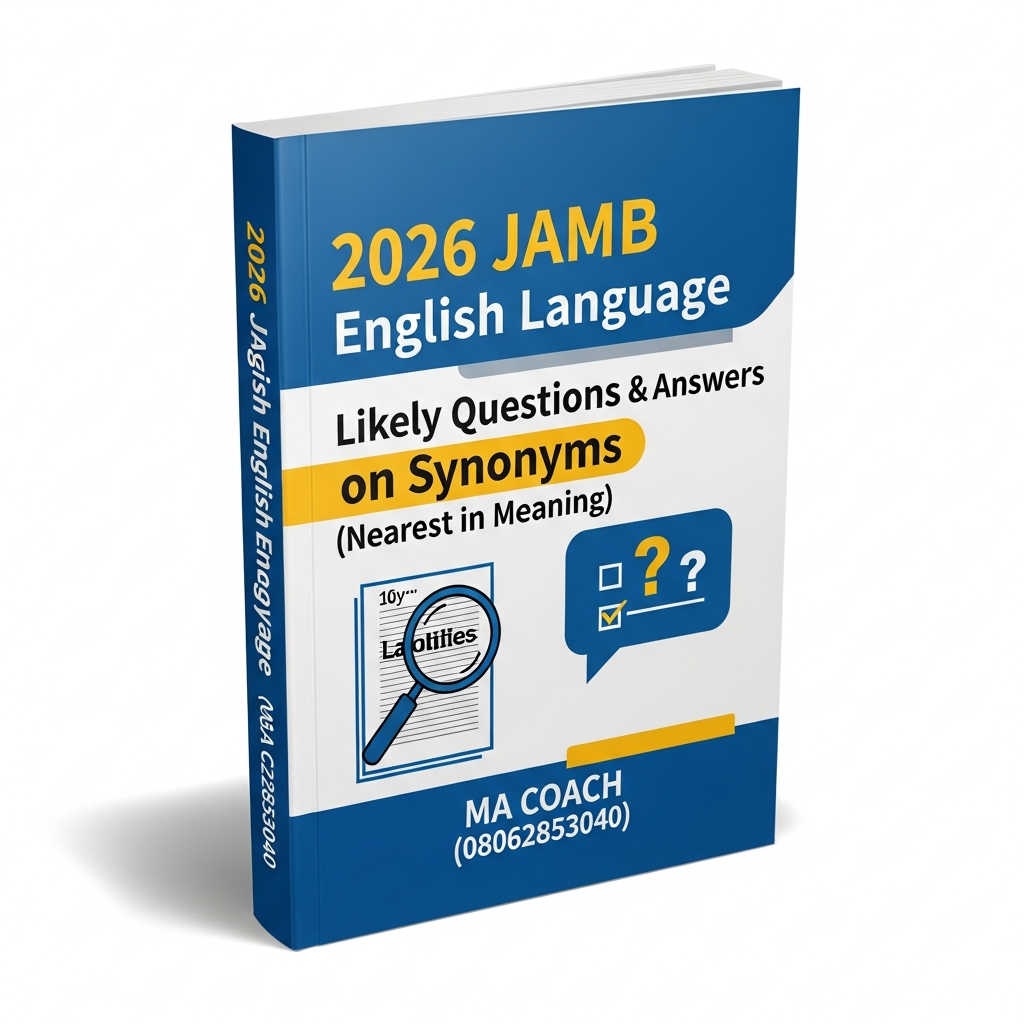
JAMB
Questions with their options:
There is no doubt that pride is less desirable a quality than _______.
A. arrogance.
B. honesty.
C. tenderness.
D. humility.
Correct option: D. humility.
Answers explanation: The word “pride” in this context refers to an excessive sense of self-importance. The opposite of this is “humility,” which means a modest or low view of one’s own importance.
Why other options are not correct:
A. “Arrogance” is a synonym of pride, not an antonym.
B. “Honesty” is a virtue but not directly opposite to the negative sense of pride.
C. “Tenderness” refers to gentleness or kindness, which is unrelated to the opposite of pride.
Questions with their options:
Few people prefer the rural to the _______ areas.
A. urban.
B. pastoral.
C. rustic.
D. central.
Correct option: A. urban.
Answers explanation: “Rural” refers to the countryside. The direct opposite of “rural” is “urban,” which refers to cities or towns.
Why other options are not correct:
B. “Pastoral” describes the countryside, so it’s a synonym for rural, not an antonym.
C. “Rustic” also relates to the countryside, often implying simplicity or lack of sophistication, making it a synonym.
D. “Central” refers to the middle or core of something, not specifically the opposite of rural.
Questions with their options:
Emeka is quite refined in his manners but his colleague is rather _______.
A. arrogant.
B. crude.
C. courtly.
D. cultured.
Correct option: B. crude.
Answers explanation: “Refined” describes someone with polite, elegant, and sophisticated manners. The opposite of this is “crude,” which means lacking refinement or sophistication, often implying rudeness or a basic manner.
Why other options are not correct:
A. “Arrogant” means having an exaggerated sense of one’s own importance, which is not directly opposite to refined manners.
C. “Courtly” means polite and refined, similar to “refined,” so it’s a synonym.
D. “Cultured” also means refined and educated, making it a synonym.
Questions with their options:
Instead of helping to preserve our culture, the youth engage in activities that _______ it.
A. denounce.
B. alter.
C. conserve.
D. destroy.
Correct option: D. destroy.
Answers explanation: “Preserve” means to maintain something in its original or existing state. The direct opposite of preserving something is to “destroy” it.
Why other options are not correct:
A. “Denounce” means to publicly declare something to be wrong or evil, which is not the opposite of preserve in terms of action.
B. “Alter” means to change something, which is not as strong an antonym as “destroy.” Preservation implies preventing change, but destruction is a complete undoing.
C. “Conserve” is a synonym of “preserve.”
Questions with their options:
We should regard donations as _______ and not compulsory.
A. mandatory.
B. necessary.
C. voluntary.
D. gratuitous.
Correct option: C. voluntary.
Answers explanation: “Compulsory” means required by law or rule; obligatory. The opposite of something being compulsory is for it to be “voluntary,” meaning done or given of one’s own free will.
Why other options are not correct:
A. “Mandatory” is a synonym of “compulsory.”
B. “Necessary” means required to be done, achieved, or present; essential, which is similar to compulsory in context.
D. “Gratuitous” means uncalled for; lacking good reason; unwarranted, or given or done free of charge. While “free of charge” could be related to donations, it’s not the direct opposite of “compulsory” in the sense of obligation.
Questions with their options:
The affluence of the politicians contrasts with the _______ of the masses.
A. poverty.
B. paucity.
C. misery.
D. plenty.
Correct option: A. poverty.
Answers explanation: “Affluence” means the state of having a great deal of money; wealth. The direct opposite of wealth or affluence is “poverty.”
Why other options are not correct:
B. “Paucity” means the presence of something only in small or insufficient quantities or amounts; scarcity. While related to lack, it’s not the direct opposite of “affluence.”
C. “Misery” refers to a state or feeling of great distress or discomfort of mind or body, which is a consequence of poverty but not its direct opposite.
D. “Plenty” means a sufficient or more than sufficient amount or supply, which is a synonym of affluence, not an antonym.
Questions with their options:
The importation of rice is permitted while that of wheat is _______.
A. allowed.
B. suspended.
C. licensed.
D. prohibited.
Correct option: D. prohibited.
Answers explanation: “Permitted” means allowed to do something. The direct opposite of permitting something is to “prohibit” it, meaning to formally forbid something by law, rule, or other authority.
Why other options are not correct:
A. “Allowed” is a synonym of “permitted.”
B. “Suspended” means temporarily prevented from continuing or being in force, which is a temporary state and not a direct opposite of being permitted.
C. “Licensed” means given official permission to do something, which is similar to being permitted.
Questions with their options:
The goal lifted the team from the agony of defeat to the _______ of victory.
A. hope.
B. desire.
C. celebration.
D. ecstasy.
Correct option: D. ecstasy.
Answers explanation: “Agony” refers to extreme physical or mental suffering. The opposite of extreme suffering, especially in the context of victory, would be extreme joy or overwhelming happiness, which is best described as “ecstasy.”
Why other options are not correct:
A. “Hope” is a feeling of expectation and desire for a particular thing to happen, which is not the direct opposite of agony.
B. “Desire” is a strong feeling of wanting to have something or wishing for something to happen, also not the direct opposite.
C. “Celebration” is the act of celebrating, which is a response to victory but not the intense emotional opposite of agony.
Questions with their options:
One species of the animal has gone into extinction while the other is still in _______.
A. antiquity.
B. execution.
C. oblivion.
D. existence.
Correct option: D. existence.
Answers explanation: “Extinction” means the state or process of a species, family, or other group of animals or plants becoming extinct. The direct opposite of extinction is “existence,” meaning the fact or state of living or having objective reality.
Why other options are not correct:
A. “Antiquity” means the ancient past, especially the period before the Middle Ages, which is unrelated to the opposite of extinction.
B. “Execution” means the carrying out or putting into effect of a plan, order, or course of action, or the carrying out of a sentence of death, which is unrelated.
C. “Oblivion” means the state of being forgotten or unknown, which can be a consequence of extinction but is not its direct opposite.
Questions with their options:
The Council ratified the controversial recommendation which we thought would be _______.
A. refuted.
B. rejected.
C. authenticated.
D. corroborated.
Correct option: B. rejected.
Answers explanation: “Ratified” means to sign or give formal consent to (a treaty, contract, or agreement), making it officially valid. The opposite of ratifying something, especially a recommendation, is to “reject” it, meaning to dismiss or refuse to accept or comply with it.
Why other options are not correct:
A. “Refuted” means to prove (a statement or theory) to be wrong or false. While related to disagreement, it’s not the direct opposite of ratifying (which is about acceptance).
C. “Authenticated” means to prove or confirm that something is true, accurate, or genuine, which is not the opposite of ratifying.
D. “Corroborated” means to confirm or give support to (a statement, theory, or finding), which is similar to authenticating and not an antonym.
Questions with their options:
The measures that were introduced to accelerate the process of national development have in actual fact ….. it.
A. accentuated.
B. retarded.
C. promoted.
D. neutralized.
Correct option: B. retarded.
Answers explanation: “Accelerate” means to increase the rate, speed, or progress of something. The opposite of accelerating is to “retard,” which means to delay or hold back in terms of progress or development.
Why other options are not correct:
A. “Accentuates” means to make more noticeable or prominent, which doesn’t fit as an antonym.
C. “Promoted” means to support or actively encourage (a cause, venture, etc.); further the progress of. This is a synonym of accelerate.
D. “Neutralized” means to make (something) ineffective by applying an opposite force or effect, or to render (something) harmless. While it stops progress, “retarded” specifically implies slowing it down.
Questions with their options:
I thought that the comments made by the secretary were quite innocuous but the chairman considered them …..
A. polite.
B. inappropriate.
C. antagonistic.
D. harmful.
Correct option: D. harmful.
Answers explanation: “Innocuous” means not harmful or offensive. The direct opposite of something not being harmful is for it to be “harmful.”
Why other options are not correct:
A. “Polite” means showing regard for others in manners, speech, and behavior, which is not the direct opposite of harmless.
B. “Inappropriate” means not suitable or proper in the circumstances, which is not the direct opposite of harmless.
C. “Antagonistic” means showing or feeling active opposition or hostility, which describes a hostile attitude, not necessarily the harm caused by comments.
Questions with their options:
The _______ of the few rich in our society contrasts with the poverty of the masses.
A. arrogance.
B. authority.
C. influence.
D. affluence.
Correct option: D. affluence.
Answers explanation: “Poverty” means the state of being extremely poor. The direct opposite of poverty is “affluence,” which means the state of having a great deal of money; wealth.
Why other options are not correct:
A. “Arrogance” means an exaggerated sense of one’s own importance or abilities, which is unrelated.
B. “Authority” means the power or right to give orders, make decisions, and enforce obedience, which is unrelated.
C. “Influence” means the capacity to have an effect on the character, development, or behavior of someone or something, or the effect itself, which is also unrelated to the direct opposite of poverty.
Questions with their options:
Bola was vocal in protesting against the high-handedness of the police unlike Sola who was _______.
A. mute.
B. shouting.
C. arguing.
D. sober.
Correct option: A. mute.
Answers explanation: “Vocal” means relating to the human voice, or expressing opinions or feelings freely and loudly. In this context, it implies speaking out. The opposite of being vocal is to be “mute,” meaning unable or unwilling to speak.
Why other options are not correct:
B. “Shouting” is an act of being vocal, so it’s a synonym.
C. “Arguing” involves speaking, often loudly, so it’s related to being vocal.
D. “Sober” means not drunk, or serious, sensible, and solemn, which is unrelated to vocal.
Questions with their options:
The rather insignificant effort he made yielded _______ results.
A. exorbitant.
B. absolute.
C. unimaginable.
D. tremendous.
Correct option: D. tremendous.
Answers explanation: “Insignificant” means too small or unimportant to be worth consideration. The opposite of insignificant is “tremendous,” which means very great in amount, scale, or intensity.
Why other options are not correct:
A. “Exorbitant” means (of a price or amount charged) unreasonably high, which refers to cost, not significance.
B. “Absolute” means not qualified or diminished in any way; total, which is a different quality than significance.
C. “Unimaginable” means difficult or impossible to imagine or comprehend, which is not the direct opposite of insignificant.
Questions with their options:
Ibrahim’s flamboyant lifestyle contrasts sharply with Aminu’s _______ attitude.
A. austere.
B. ostentatious.
C. serious.
D. lavish.
Correct option: A. austere.
Answers explanation: “Flamboyant” means (of a person or their behavior) tending to attract attention because of their exuberance, confidence, and stylishness, often implying showiness. The opposite of this showy and extravagant style is “austere,” which means severe or strict in manner, attitude, or appearance; very simple and unadorned.
Why other options are not correct:
B. “Ostentatious” means characterized by vulgar or pretentious display; designed to impress or attract notice, which is a synonym of flamboyant.
C. “Serious” means acting or speaking sincerely and in earnest, which is a different aspect from being flamboyant.
D. “Lavish” means sumptuously rich, elaborate, or luxurious, which is a synonym of flamboyant.
Questions with their options:
The young man was advised to be _______ and not rigid on critical issues if he wanted to make a good career in politics.
A. wavering.
B. evasive.
C. cautious.
D. flexible.
Correct option: D. flexible.
Answers explanation: “Rigid” means unable to bend or be forced out of shape; not flexible, or (of a person or system) unable to change or adapt. The opposite of being rigid, especially in an abstract sense like political stances, is to be “flexible,” meaning able to bend easily without breaking, or able to change or be changed easily according to the situation.
Why other options are not correct:
A. “Wavering” means indecisive or hesitating, which is not the opposite of rigid.
B. “Evasive” means tending to avoid commitment or self-revelation, especially by responding indirectly, which is unrelated to rigidity.
C. “Cautious” means (of a person) careful to avoid potential problems or dangers, which is not the opposite of rigid.
Questions with their options:
At the end of the crisis, the leaders declared that there was neither victor nor _______.
A. winner.
B. oppressor.
C. vanquished.
D. originator.
Correct option: C. vanquished.
Answers explanation: A “victor” is a person who defeats an enemy or opponent in a battle, game, or other contest; a winner. The direct opposite of a victor in a conflict is someone who is “vanquished,” meaning defeated thoroughly.
Why other options are not correct:
A. “Winner” is a synonym of “victor.”
B. “Oppressor” is a person who treats another person or group in an unfair or cruel way and prevents them from having rights or opportunities, which is not the direct opposite of a victor.
D. “Originator” is a person who creates or initiates something, which is unrelated.
Questions with their options:
Rather than show remorse for his offence, he remained _______.
A. calculated.
B. unpleasant.
C. apathetic.
D. unrepentant.
Correct option: D. unrepentant.
Answers explanation: “Remorse” means deep regret or guilt for a wrong committed. The opposite of showing remorse is to be “unrepentant,” meaning showing no regret for one’s wrongdoings.
Why other options are not correct:
A. “Calculated” means (of an action) done with full awareness of the likely consequences, which is unrelated to remorse.
B. “Unpleasant” means not pleasant or agreeable, which is a general negative description and not specific to remorse.
C. “Apathetic” means showing or feeling no interest, enthusiasm, or concern, which implies a lack of emotion, but not specifically the opposite of remorse.
Questions with their options:
The workers expected management to be… rather than indifferent to their welfare.
A. different from.
B. interested in.
C. opposed to.
D. careful of.
Correct option: B. interested in.
Answers explanation: “Indifferent” means having no particular interest or sympathy; unconcerned. The opposite of being indifferent to someone’s welfare is to be “interested in” it.
Why other options are not correct:
A. “Different from” is a general comparison and not the antonym for indifference.
C. “Opposed to” means being against something, which is a specific stance, not the opposite of a lack of concern.
D. “Careful of” implies caution, which is not the direct opposite of indifference.
Questions with their options:
Words spoken in the heat of an argument could offend rather than _______.
A. pacify.
B. amuse.
C. inspire.
D. irritate.
Correct option: A. pacify.
Answers explanation: “Offend” means to cause to feel upset, annoyed, or resentful. The opposite of offending someone, especially in an argument, is to “pacify” them, meaning to quell the anger, agitation, or excitement of.
Why other options are not correct:
B. “Amuse” means to cause (someone) to find something funny, which is not the direct opposite of offending.
C. “Inspire” means to fill (someone) with the urge or ability to do or feel something, especially to do something creative, which is unrelated to the context of offending in an argument.
D. “Irritate” means to make (someone) annoyed, impatient, or angry; which is a synonym of offend.
Questions with their options:
Although they have declared the student a suspect, he may turn out to be _______
A. culpable.
B. innocent.
C. safe.
D. ignorant.
Correct option: B. innocent.
Answers explanation: A “suspect” is a person thought to be guilty of a crime or offence. The direct opposite of being a suspect or being culpable is to be “innocent,” meaning not guilty of a crime or offence.
Why other options are not correct:
A. “Culpable” means deserving blame, which is similar to being a suspect or guilty, so it’s a synonym.
C. “Safe” means protected from or not exposed to danger or risk, which is a different aspect than guilt.
D. “Ignorant” means lacking knowledge or awareness in general; uneducated or unsophisticated, which is unrelated.
Questions with their options:
Some outspoken social critics live a _______ family life.
A. reserved.
B. happy.
C. boisterous.
D. still.
Correct option: A. reserved.
Answers explanation: “Outspoken” means frank in stating one’s opinions, especially if they are shocking or controversial. The opposite of being outspoken, particularly in personal life, is to be “reserved,” meaning slow to reveal emotion or opinions.
Why other options are not correct:
B. “Happy” describes a state of emotion, not a manner of expression.
C. “Boisterous” means (of a person, event, or behavior) noisy, energetic, and cheerful; rowdy, which could be related to outspokenness, not its opposite.
D. “Still” means not moving or making a sound, which is literal and not the appropriate antonym for outspoken.
Questions with their options:
Polygamy is very common in Africa, whereas the only acceptable form of marriage in Europe is _______.
A. celibacy.
B. polyandry.
C. ordination.
D. monogamy.
Correct option: D. monogamy.
Answers explanation: “Polygamy” is the practice or custom of having more than one wife or husband at the same time. The opposite of polygamy, which is a marriage to one person, is “monogamy.”
Why other options are not correct:
A. “Celibacy” is the state of abstaining from marriage and sexual relations, which is not a form of marriage.
B. “Polyandry” is a form of polygamy in which a woman has more than one husband, so it’s a type of polygamy, not its opposite.
C. “Ordination” is the action of conferring holy orders on someone, which is a religious ceremony and not a type of marriage structure.
Questions with their options:
While the manager was prudent in his expenditure, his deputy was _______.
A. miserly.
B. careful.
C. thoughtful.
D. extravagant.
Correct option: D. extravagant.
Answers explanation: “Prudent” means acting with or showing care and thought for the future. In terms of expenditure, it means being careful with money. The opposite of prudent expenditure is “extravagant” expenditure, meaning lacking restraint in spending money or using resources.
Why other options are not correct:
A. “Miserly” means (of a person) characterized by or indicative of a lack of generosity, which is extreme prudence but not its direct opposite in the sense of spending.
B. “Careful” is a synonym of prudent.
C. “Thoughtful” means considerate or showing careful consideration, which is related to prudence but not its direct opposite in spending.
Questions with their options:
The principal wants us to _______ the motion, so don’t oppose it.
A. sustain.
B. support.
C. defame.
D. applaud.
Correct option: B. support.
Answers explanation: “Oppose” means to disapprove of and attempt to prevent, especially by argument. The direct opposite of opposing a motion is to “support” it.
Why other options are not correct:
A. “Sustain” means to strengthen or support physically or mentally, or to undergo (an attack, injury, or operation). While it has a sense of support, “support” is more direct for a motion.
C. “Defame” means to damage the good reputation of (someone); slander or libel, which is unrelated to a motion.
D. “Applaud” means to show approval or praise by clapping, which is a form of showing support but “support” is the more direct antonym for “oppose” in this context.
Questions with their options:
He denied that he ever _______ committing the offence in his earlier statement.
A. admitted.
B. argued.
C. emphasized.
D. negated.
Correct option: A. admitted.
Answers explanation: “Denied” means stated that one refuses to admit the truth or existence of. The direct opposite of denying something, especially committing an offence, is to “admit” it.
Why other options are not correct:
B. “Argued” means to give reasons or cite evidence in support of an idea, action, or theory, typically with the aim of persuading others to share one’s view, which is not the opposite of denied.
C. “Emphasized” means to give special importance or prominence to (something) in speaking or writing, which is unrelated.
D. “Negated” means to nullify or make ineffective, which is closer to denied but “admitted” is the more precise antonym for a statement about an offence.
Questions with their options:
The cultured and the _______ are known by their conduct.
A. barbaric.
B. ignorant.
C. clean.
D. lazy.
Correct option: A. barbaric.
Answers explanation: “Cultured” means characterized by refined taste and manners and good education. The opposite of cultured, implying a lack of refinement and civilization, is “barbaric.”
Why other options are not correct:
B. “Ignorant” means lacking knowledge, which is related but not the comprehensive opposite of cultured manners and taste.
C. “Clean” refers to neatness or freedom from dirt, which is unrelated to cultural refinement.
D. “Lazy” means unwilling to work or use energy, which is unrelated.
Questions with their options:
The brevity of the Guest-of-honour’s address contrasts with the _______ of the Chairman’s opening remarks.
A. intensity.
B. propensity.
C. solidity.
D. verbosity.
Correct option: D. verbosity.
Answers explanation: “Brevity” means concise and exact use of words in writing or speech; shortness of time. The opposite of brevity in speech is “verbosity,” which means the quality of using more words than needed; wordiness.
Why other options are not correct:
A. “Intensity” means the quality of being intense, which refers to strength or fervor, not length.
B. “Propensity” means an inclination or natural tendency to behave in a particular way, which is unrelated.
C. “Solidity” means the quality or state of being firm, strong, or three-dimensional, which is unrelated.
Questions with their options:
The long trek exhausted him so he needed to rest to _______ himself.
A. repose.
B. remake.
C. recuperate.
D. replace.
Correct option: C. recuperate.
Answers explanation: “Exhausted” means drained of one’s physical or mental resources; very tired. To recover from exhaustion, one needs to “recuperate,” which means to recover from illness or exertion.
Why other options are not correct:
A. “Repose” means a state of rest, sleep, or tranquility. While related to rest, “recuperate” specifically implies recovery from an exhausting state.
B. “Remake” means to make again or in a different way, which is unrelated.
D. “Replace” means to take the place of, which is unrelated.
Questions with their options:
Many Africans now live in abject poverty instead of enjoying the _______ of their countries.
A. comfort.
B. greatness.
C. possessions.
D. affluence.
Correct option: D. affluence.
Answers explanation: “Poverty” means the state of being extremely poor. The direct opposite of poverty is “affluence,” which means the state of having a great deal of money; wealth.
Why other options are not correct:
A. “Comfort” refers to a state of physical ease and freedom from pain or constraint, or the easing of a person’s feelings of grief or distress. While related to wealth, it’s not the direct opposite.
B. “Greatness” means the quality of being great, distinguished, or eminent, which is a different concept.
C. “Possessions” are the things owned, which are a result of affluence but not the state itself.
Questions with their options:
The motorists said the splashing of the waters was _______ not deliberate.
A. incidental.
B. intentional.
C. accidental.
D. avoidable.
Correct option: B. intentional.
Answers explanation: “Deliberate” means done consciously and intentionally; planned. The question asks for the opposite of “not deliberate.” Therefore, the opposite of “not deliberate” is “intentional” (or deliberate itself). Given the options, “intentional” is the best fit.
Why other options are not correct:
A. “Incidental” means happening as a minor accompaniment to something else.
C. “Accidental” means happening by chance or unexpectedly. This is a synonym of “not deliberate.”
D. “Avoidable” means able to be avoided or prevented. This refers to possibility, not intent.
Questions with their options:
One of the aims of the structural adjustment policy is to make us _______ rather than consumers.
A. parasites.
B. developers.
C. designers.
D. producers.
Correct option: D. producers.
Answers explanation: “Consumers” are people who buy goods and services. The opposite of a consumer, in terms of economic activity, is a “producer,” which is a person, company, or country that makes, grows, or supplies goods or commodities for sale.
Why other options are not correct:
A. “Parasites” are organisms that live on or in a host and gets its food from or at the expense of its host. This is a negative connotation and not the direct economic opposite of a consumer.
B. “Developers” are people who develop something. While they can be producers, “producers” is a broader and more direct antonym for “consumers.”
C. “Designers” are people who plan and make decisions about the way something is made or done. They are involved in the production process but are not the overall opposite of consumers.
Questions with their options:
Tunde seldom asks questions in class and was _______ very careful when he did.
A. hardly.
B. sometimes.
C. often.
D. never.
Correct option: C. often.
Answers explanation: “Seldom” means not often; rarely. The direct opposite of “seldom” is “often.”
Why other options are not correct:
A. “Hardly” means barely or scarcely, which suggests a low frequency, similar to seldom.
B. “Sometimes” means occasionally, which is not the direct opposite of seldom, but rather a moderate frequency.
D. “Never” means at no time; not ever, which is an absolute opposite but “often” indicates the general contrast to “seldom.”
Questions with their options:
The computerized services of the new bank contrast with the _______ operations of the old ones.
A. mechanical.
B. electrical.
C. aerial.
D. manual.
Correct option: D. manual.
Answers explanation: “Computerized” means done or controlled by computer. The opposite of computerized or automated operations is “manual” operations, meaning done by hand.
Why other options are not correct:
A. “Mechanical” refers to operating or produced by a machine or machinery. While not computerized, it’s not the direct opposite in the way “manual” is.
B. “Electrical” refers to operating with or dependent on electricity, which can apply to both computerized and mechanical systems.
C. “Aerial” refers to existing, happening, or operating in the air, which is unrelated.
Questions with their options:
Tunde says he always looks sober because there is nothing to be _______ about.
A. serious.
B. excited.
C. happy.
D. witty.
Correct option: B. excited.
Answers explanation: “Sober” means not drunk; serious, sensible, and solemn. In this context, it implies a lack of cheerfulness or enthusiasm. The opposite of being sober (in the sense of not cheerful/enthusiastic) is to be “excited.”
Why other options are not correct:
A. “Serious” is a synonym of sober in this context.
C. “Happy” is a general positive emotion, while “excited” more directly contrasts with the solemn aspect of “sober.”
D. “Witty” means showing or characterized by quick and inventive verbal humor, which is unrelated to the emotional state implied by sober.
Questions with their options:
I felt as if I was in an oven throughout my stay in the Sahara, while our room here in Jos is like a _______.
A. freezer.
B. chimney.
C. ventilator.
D. furnace.
Correct option: A. freezer.
Answers explanation: An “oven” is an enclosed compartment, usually part of a cooker, for cooking and heating food. It’s associated with intense heat. The direct opposite in terms of temperature for a room would be a “freezer,” which is an appliance for preserving food at very low temperatures.
Why other options are not correct:
B. “Chimney” is a vertical channel from a fireplace or furnace, which is unrelated to the temperature opposite.
C. “Ventilator” is an appliance or aperture for ventilating a room or other space, which helps with air circulation but is not the direct opposite of an oven’s heat.
D. “Furnace” is an enclosed structure in which material can be heated to very high temperatures, so it’s a synonym for an oven’s function, not an antonym.
Questions with their options:
The minister was accused of making utterances that could increase rather than _______ anxiety among the citizen.
A. modify.
B. diminish.
C. intensify.
D. remove.
Correct option: B. diminish.
Answers explanation: “Increase” means to become or make greater in size, amount, or degree. The direct opposite of increasing something is to “diminish” it, meaning to make or become less.
Why other options are not correct:
A. “Modify” means to make partial or minor changes to (something), which is not the direct opposite of increasing.
C. “Intensify” means to become or make more intense, which is a synonym of increase.
D. “Remove” means to take (something) away or off from the position occupied, which implies complete elimination, whereas “diminish” implies a reduction.
Questions with their options:
At the end of the crisis, the leader declared that there was neither victor nor _______.
A. winner.
B. rebel.
C. patriot.
D. vanquished.
Correct option: C. vanquished.
Answers explanation: A “victor” is a person who defeats an enemy or opponent in a battle, game, or other contest; a winner. The direct opposite of a victor in a conflict is someone who is “vanquished,” meaning defeated thoroughly.
Why other options are not correct:
A. “Winner” is a synonym of “victor.”
B. “Rebel” is a person who rises in opposition or armed resistance against an established government or ruler, which is not the direct opposite of a victor.
C. “Patriot” is a person who vigorously supports their country and is prepared to defend it against enemies or detractors, which is unrelated.
Questions with their options:
I was impressed by the man’s eagerness but was rather put off by his wife’s _______.
A. anxiety.
B. impatience.
C. indifference.
D. negligence.
Correct option: C. indifference.
Answers explanation: “Eagerness” means enthusiasm to do or to have something; keenness. The opposite of eagerness, implying a lack of interest or concern, is “indifference.”
Why other options are not correct:
A. “Anxiety” means a feeling of worry, nervousness, or unease about something with an uncertain outcome, which is a different emotional state.
B. “Impatience” means the tendency to be impatient, which is a form of eager or restless waiting, not the opposite of eagerness.
D. “Negligence” means failure to take proper care in doing something, which is a behavior, not an attitude opposite to eagerness.
Questions with their options:
He is a famous artist but has a _______ drinking habit.
A. remarkable.
B. admirable.
C. notorious.
D. wicked.
Correct option: C. notorious.
Answers explanation: “Famous” means known about by many people. When talking about a negative habit like drinking, the corresponding term for being widely known for something bad is “notorious.”
Why other options are not correct:
A. “Remarkable” means worthy of attention; striking, usually in a positive sense.
B. “Admirable” means arousing or deserving respect and approval, which is positive.
D. “Wicked” means evil or morally wrong. While a drinking habit might be considered wicked, “notorious” directly contrasts with “famous” in the context of being known for something negative versus positive.
Questions with their options:
The first twin is so vain and the second so _______ that one would think they were not brothers.
A. proud.
B. complacent.
C. selfish.
D. humble.
Correct option: D. humble.
Answers explanation: “Vain” means having or showing an excessively high opinion of one’s appearance, abilities, or worth. The opposite of vain is “humble,” meaning having or showing a modest or low estimate of one’s own importance.
Why other options are not correct:
A. “Proud” means feeling deep pleasure or satisfaction as a result of one’s own achievements, qualities, or possessions or those of someone with whom one is closely associated. This can be positive but also can lean towards vanity.
B. “Complacent” means showing smug or uncritical satisfaction with oneself or one’s achievements, which is similar to vanity.
C. “Selfish” means (of a person, action, or motive) lacking consideration for others; concerned chiefly with one’s own personal profit or pleasure, which is a different negative trait.
Questions with their options:
Mary: “I wonder why armed robbers are so hard-hearted.” John: “The fact is that to be an armed robber you cannot be _______.”
A. considerate.
B. intolerant.
C. revengeful.
D. soft-spoken.
Correct option: A. considerate.
Answers explanation: “Hard-hearted” means unsympathetic; unkind. The opposite of hard-hearted is “considerate,” meaning careful not to inconvenience or harm others.
Why other options are not correct:
B. “Intolerant” means not tolerant of views, beliefs, or behavior that differ from one’s own, which is a different trait.
C. “Revengeful” means eager for revenge, which is a specific negative motivation.
D. “Soft-spoken” refers to speaking quietly and gently, which is about voice, not character.
Questions with their options:
To ascend this steep hill is the problem, to _______ is quite easy.
A. depart.
B. decline.
C. drop.
D. descend.
Correct option: D. descend.
Answers explanation: “Ascend” means to go up or climb. The direct opposite of ascending is to “descend,” meaning to move or fall downwards.
Why other options are not correct:
A. “Depart” means to leave, which is a general movement away, not specifically down.
B. “Decline” means to (typically of something regarded as good) become smaller, fewer, or less; decrease. It can mean to go downward in a general sense, but “descend” is more specific to physical movement on a hill.
C. “Drop” means to fall vertically, which is a type of downward movement but “descend” is the more direct and appropriate antonym for “ascend.”
Questions with their options:
Working in the field is easy when your machete is sharp and not when it is _______.
A. jagged.
B. coarse.
C. sound.
D. blunt.
Correct option: D. blunt.
Answers explanation: “Sharp” means (of an edge or point) able to cut or pierce. The direct opposite of sharp is “blunt,” meaning (of a knife, pencil, etc.) not sharp; dull.
Why other options are not correct:
A. “Jagged” means having a rough, uneven, and typically pointed shape or outline; ragged, which describes a rough edge but not necessarily a dull one.
B. “Coarse” means (of a person’s speech or behavior) rude, crude, or vulgar; or (of fabric or grain) rough or loose in texture, which is unrelated to sharpness.
C. “Sound” means in good condition; not damaged, which is unrelated to sharpness.
Questions with their options:
The gradual process of transition to civil rule came to an _______ end.
A. unnecessarily.
B. anticipated.
C. invidious.
D. abrupt.
Correct option: D. abrupt.
Answers explanation: “Gradual” means taking place or progressing slowly or by degrees. The direct opposite of gradual is “abrupt,” meaning sudden and unexpected.
Why other options are not correct:
A. “Unnecessarily” means to an extent or in a way that is not necessary, which is an adverb of manner, not an antonym for gradual.
B. “Anticipated” means regarded as probable; expected, which is unrelated to the pace of an end.
C. “Invidious” means (of an action or situation) likely to arouse resentment or anger in others, which is unrelated.
Questions with their options:
The exterior and the _______ parts of the fruit remain very hard even after it is ripe.
A. inward.
B. inner.
C. intrinsic.
D. peripheral.
Correct option: B. inner.
Answers explanation: “Exterior” refers to the outer surface or structure of something. The direct opposite of the exterior is the “inner” part.
Why other options are not correct:
A. “Inward” means directed or proceeding towards the inside, which is an adverb or adjective describing direction, not a noun for the part.
C. “Intrinsic” means belonging naturally; essential, which describes a quality, not a physical part.
D. “Peripheral” means relating to or situated on the edge or periphery of something, which is closer to exterior than its opposite.
Questions with their options:
Ibrahim was full of admiration for Amina but she treated him with _______
A. amusement.
B. freedom.
C. disdain.
D. disgrace.
Correct option: C. disdain.
Answers explanation: “Admiration” means respect and warm approval. The direct opposite of admiration is “disdain,” meaning the feeling that someone or something is unworthy of one’s consideration or respect; contempt.
Why other options are not correct:
A. “Amusement” means the state or experience of finding something funny, which is a different emotion.
B. “Freedom” means the power or right to act, speak, or think as one wants without hindrance or restraint, which is unrelated.
D. “Disgrace” means loss of reputation or respect, typically as the result of a dishonorable action, which is a consequence, not the emotion itself.
Questions with their options:
The economist argued that the apparently inconsequential rise in the price of petrol had a _______ effect on the cost of living.
A. capricious.
B. frivolous.
C. dangerous.
D. drab.
Correct option: C. dangerous.
Answers explanation: “Inconsequential” means not important or significant. The opposite of inconsequential, especially concerning an effect on the cost of living, implies a significant or “dangerous” impact. While “dangerous” isn’t a perfect antonym for “inconsequential,” it conveys the significant, negative impact that an economist would highlight as the opposite of unimportant.
Why other options are not correct:
A. “Capricious” means given to sudden and unaccountable changes of mood or behavior, which is unrelated to effect.
B. “Frivolous” means not having any serious purpose or value, which is similar to inconsequential, not its opposite.
D. “Drab” means lacking brightness or interest; dingy or dull, which is unrelated to effect.
Questions with their options:
The exotic bird, looked resplendent; its bright plumage contrasted with the rather _______ undergrowth.
A. immobile.
B. foreign.
C. extraneous.
D. drab.
Correct option: D. drab.
Answers explanation: “Resplendent” means shining brightly; dazzling or splendid, especially in appearance. The phrase “bright plumage” emphasizes this. The opposite of bright and splendid is “drab,” meaning lacking brightness or interest; dingy or dull.
Why other options are not correct:
A. “Immobile” means not moving; motionless, which is unrelated to appearance.
B. “Foreign” means of, from, in, or characteristic of a country or language other than one’s own, which is unrelated.
C. “Extraneous” means irrelevant or unrelated to the subject being dealt with, which is unrelated.
THANKS, BEST OF LUCK
+2349061221656, +2348062853040
admin@macoach.com.ng
+2349061221656, +2348062853040
admin@macoach.com.ng
2nd Floor former joybell nursery & primary school opposite lotogbe junction ondo city, ondo state
Monday — Friday 8am – 11pm
Saturday — 8am – 10pm
Sunday — Closed
MACOACH.com.ng –Your No.1 Online Academy for Daily Mathematics Lessons, Textbook Solutions, and Exam Preparation in Nigeria.

© 2025 Created with MA COACH